
An AI agent does better work when it starts from a maintained record of the business, and OpenAI’s 21 September 2026 case study on V7 is a clear example of why. The study opens with the problem in two questions: which fund report is current, and how is the same entity named across three systems? Today’s models can reason through a task, the study says, but they do not automatically understand the business context behind it.
V7 answers that with a structured memory its agents query before they act. A small business does not need V7’s software to use the same idea. It needs a short, maintained record of its own business that every AI task starts from.
Want this built for you?
Animus Engine installs the marketing brain and the engine that runs on it. A human hand on every gate.
What OpenAI Published About V7 on 21 September 2026
OpenAI’s case study describes V7 Go, an agent platform that turns scattered company files into a memory its agents can query and act on. V7 was started in 2018 by Alberto Rizzoli and Simon Edwardsson to help companies teach AI systems how their businesses work, according to the case study on OpenAI’s site.
The memory is called the Context Graph. When files arrive from repositories such as SharePoint and Google Drive, V7 Go scans them for entities, relationships, facts and metrics, connects each fact to a record, and keeps the cited evidence that links it back to the original source. The study says agents otherwise “have to rediscover context on every request”, which costs time and often misses information buried in relationships.
“To solve hard enterprise use cases across finance and insurance, AI needs to learn how your business operates just as well as it learned from the Internet.”
Alberto Rizzoli, co-founder and chief executive of V7, quoted in OpenAI’s case study
The case study centres on firms in finance, insurance and real estate, and it describes V7 extracting information from millions of files. The scale is different from a small business. The problem is the same one: the AI starts each task without knowing the business.
Tell Us the Task That Eats Your Week
Name one marketing job you’d hand off tomorrow. We’ll send back how we’d run it with AI — the steps, the tools, and where a human stays in charge. A real reply from Chris within one business day.
The Results V7 Reports, and Whose Numbers They Are
Every figure in the case study is V7’s own measurement or a customer result V7 reports, published by the model provider. None is an independent test. They show what V7 observed after giving agents organized context, not what the same approach will do in another business.
Figures From OpenAI’s 21 September 2026 V7 Case Study, With Their Limits
| Figure | What the case study says it measures | Whose measurement | What it is not |
|---|---|---|---|
| 99.9% | Accuracy V7 says its agents reach on 50 to 100 step workflows completed in minutes | V7’s own statement | An independent audit, or a figure for simpler setups |
| 69% and 38% | How far V7’s retrieval-only system beat the official baseline on the HERB benchmark, and how much it cut hallucinations on unanswerable queries | V7’s test on a public benchmark | A result from a live customer workflow |
| 13.5% | Fewer errors in insurance claims processing than a manual baseline, after agents were given the history of previous claims and existing policies | V7’s report of customer results | A controlled study, or a result outside claims processing |
| 2.7% to 0.2% | Tool-call error rate in V7’s Context Graph benchmark, moving from GPT-5.5 to GPT-5.6 Sol | V7’s internal benchmark | A measure of context: this one compares two models |
The insurance row is the one worth reading twice, because the case study ties that result to giving the agents the business’s own history of claims and policies. The last row is a different kind of result, a model change measured on the same benchmark, and it is shown so the two effects are not confused.
Why the Record Matters More Than the Model You Pick
V7’s description of the problem is that agents rediscover context on every request, and a small business using a chat assistant meets the same problem at the start of every conversation. A new chat does not know which price list is current or what you call your services.
In my view, what small businesses get wrong about AI is vague prompts and no rules system governing the output. A vague prompt asks the model to guess the context. A rules system writes the context down once, so the model does not have to guess and you do not have to retype it.
This is also why a newer model is not the first fix to reach for. The V7 study credits model upgrades with real gains, including the tool-call error figure in the table above. It credits the Context Graph with keeping workflows grounded in each company’s own information, which is the part a model upgrade does not supply.
What AI Business Context Looks Like for a Small Business
For a small business, AI business context is a short written record with four parts, taken from the problems V7’s case study names. It fits in a single shared document, and it is our adaptation of V7’s approach, not something V7 prescribes.
- Name what is current, so the AI never works from last year’s offer.
- Name each product, service and customer group the same way everywhere.
- Keep a source beside every fact, so a claim can be traced back.
- List what the AI may not say or do on the business’s behalf.
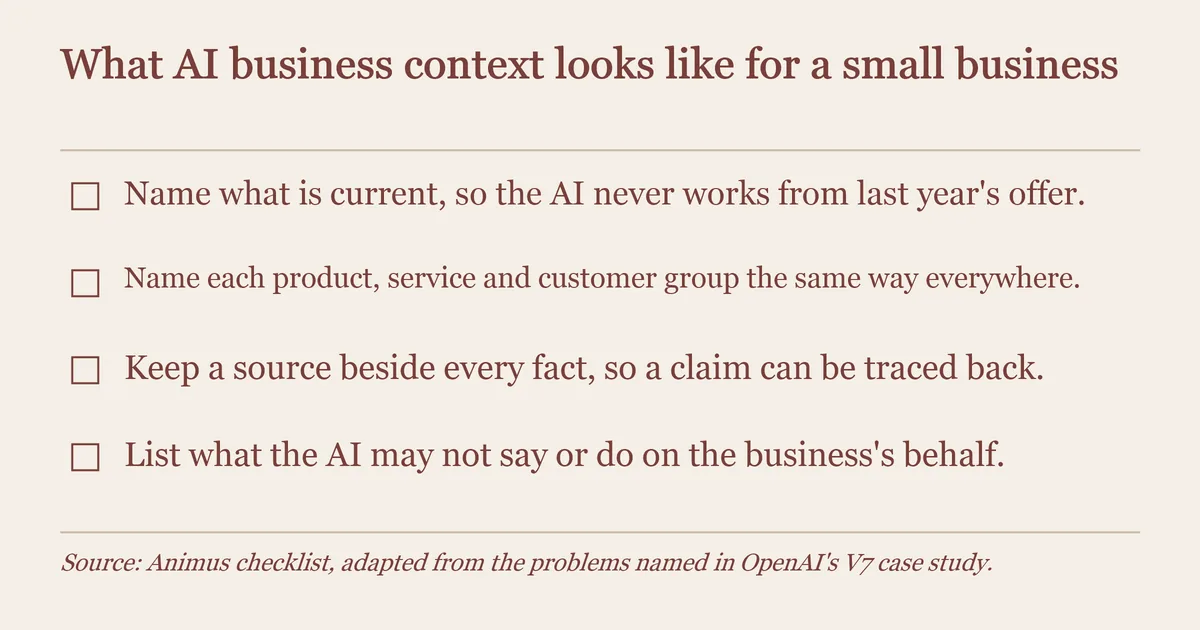
The first two parts answer V7’s opening questions directly: which report is current, and what the same thing is called across systems. The third mirrors the cited evidence V7 keeps on every fact. The fourth is the rules system, and it is the part a vague prompt leaves out.
Where the Rules Come In
V7 keeps an auditable trace of every run, and the case study gives the reason plainly: a single upstream error can lead to expensive consequences and broken trust. A small business needs the lighter version of the same control: rules the AI follows, and a person who checks the output against them.
The biggest mistake I made building my own AI system was vague instructions and letting it run unsupervised, and it made the build take far longer. Written rules are what replace the vague instruction. Checking the output is what replaces running unsupervised.
This is the working order we would use to put a business record to work.
- Write the record of what is current and what things are called.
- Give the record to the AI at the start of every task.
- Check each output against the record before it is used.
- Update the record the day a fact changes.
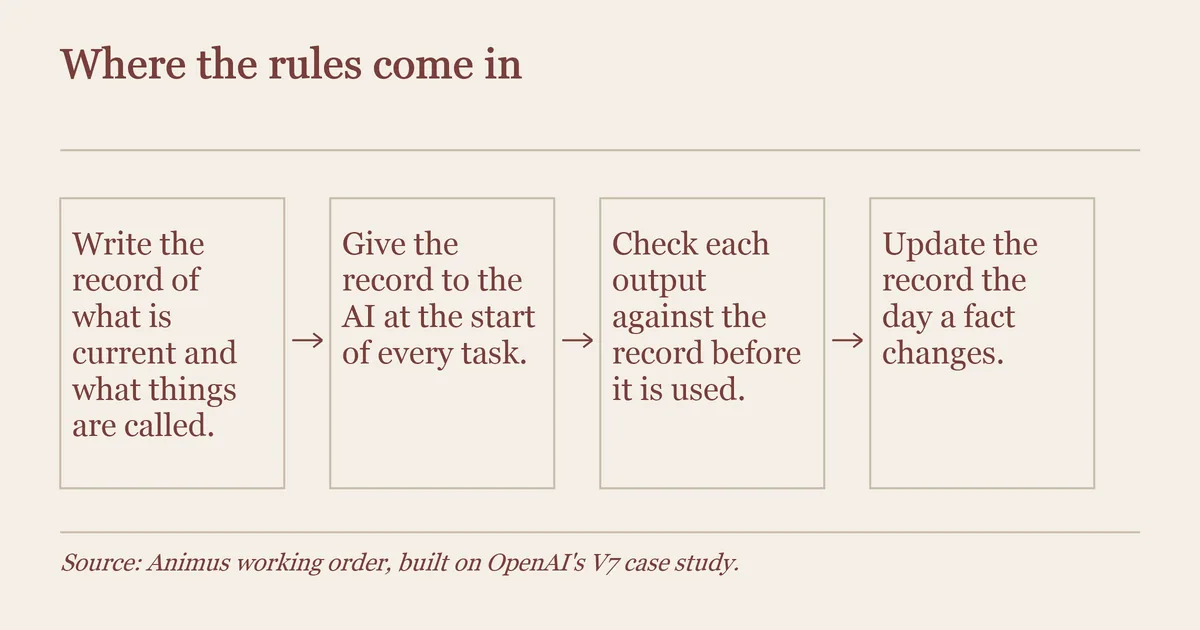
The last step is where V7 says it is heading. Its stated goal is workflows that start when facts in the graph change, so that a restated fund report flags any work still relying on the old figures. A small business can do the manual version of that today: when a price or a policy changes, the record changes first.
What the V7 Story Does Not Tell a Small Business
The case study describes firms with millions of files and workflows of 50 to 100 steps, and it says nothing about businesses with a handful of documents. Its results are reported by V7 and published by OpenAI, the company whose models V7 uses, so they are best read as a description of an approach rather than a forecast for your business.
It also does not say that a small business needs a graph or an agent platform. The transferable lesson is narrower than that: the AI does better work when it starts from the business’s own facts, kept current, with a source for each. We covered where AI fits in the rest of a marketing week in how to use AI in marketing.
Next step: write down what is current in your business on one page, then book a strategy call and bring that page with you.