
Social first content is a post built to deliver its whole point inside the feed, so a person scrolling past gets the value without clicking anywhere. For a small business, that means one idea per post, readable with the sound off, with your business named on it. The opposite is a link-first post: a teaser whose real content sits on your website, and which asks a busy stranger to stop and leave the app before they get anything.
I run the marketing for my own businesses myself, and the shift that matters is small. You stop treating social posts as signposts to your website and start treating each one as the finished piece of work. The website still matters. It is where people go after the feed has already done its job.
Want this built for you?
Animus Engine installs the marketing brain and the engine that runs on it. A human hand on every gate.
What social first content means for a small business
Social first content means the post is the product, not the advert for the product. A plumber who posts “New blog: five signs your water heater is failing” with a link has made a signpost. A plumber who posts one photo of a corroded tank valve with the caption “This is the first sign. If yours looks like this, call before winter” has made the thing itself.
The second post does its work whether or not anyone clicks. It teaches one fact, it shows the business knows its trade, and it names the next action. Someone who never visits the website still leaves with the point.
That is the whole idea. It is not a platform trick, and it does not depend on which app you use. It is a decision about where the value sits: in the post, or somewhere the reader has to travel to.
Tell Us the Task That Eats Your Week
Name one marketing job you’d hand off tomorrow. We’ll send back how we’d run it with AI — the steps, the tools, and where a human stays in charge. A real reply from Chris within one business day.
Why a link-first post loses the scroll
A link-first post asks for two decisions where a social first post asks for one. The reader has to decide the post is interesting and then decide to leave the app to find out why. Each extra decision is a place to lose them.
The feed is also a crowded room. Your post sits between a friend’s holiday photos, a news clip and an advert from a company with a far larger budget. A teaser line does not compete well there, because it withholds the one thing that would make a stranger stop: the useful part.
None of this means links are useless. A person who already trusts you will click through for a booking page or a price list. The mistake is using the link to carry content that should have been in the post.
Link-first post vs social first post: what changes
| Question | Link-first post | Social first post |
|---|---|---|
| Where does the useful part live? | On your website, behind the link | In the post itself |
| What does the reader have to do to get it? | Stop, click, wait for a page to load, then read | Stop and read |
| What happens if nobody clicks? | The post delivered nothing | The post still taught one thing and named your business |
| What is the link for? | Carrying the content | The next step for someone already interested: booking, prices, directions |
| What does it take to make? | A website article first, then a teaser | One real piece of your work, photographed or explained |
How to turn one job into a week of social first posts
One finished job can supply several social first posts, because every job holds a problem, a decision, a result and a lesson. You do not need a content calendar full of invented topics. You need the habit of capturing the work you already do.
The working order is simple, and it fits inside the job rather than after it.
From one job to four posts: the working order

- Photograph the problem before you touch it
- Note the one decision you made and why
- Photograph the finished result
- Write one post per moment, in customer words
Write each post the way you would explain that moment to a customer standing in front of you. Plain words beat polished ones here, because the reader decides quickly whether you know your trade.
A landscaper who clears an overgrown bed on Monday has, by Friday, a before photo, an after photo, a note on which plants were kept and why, and a short answer to the question the owner asked. That is four posts, each one complete on its own, and none of them required a new idea.
For more on building the wider content habit behind this, our guide to content marketing for a small business covers the work that sits around the feed.
A social first content checklist before you post
A social first post passes five checks before it goes out: one point, readable without sound, understandable without the link, your business named, and one clear next step. If a post fails any of them, fix that part rather than posting it anyway.
The five checks before a social first post goes out
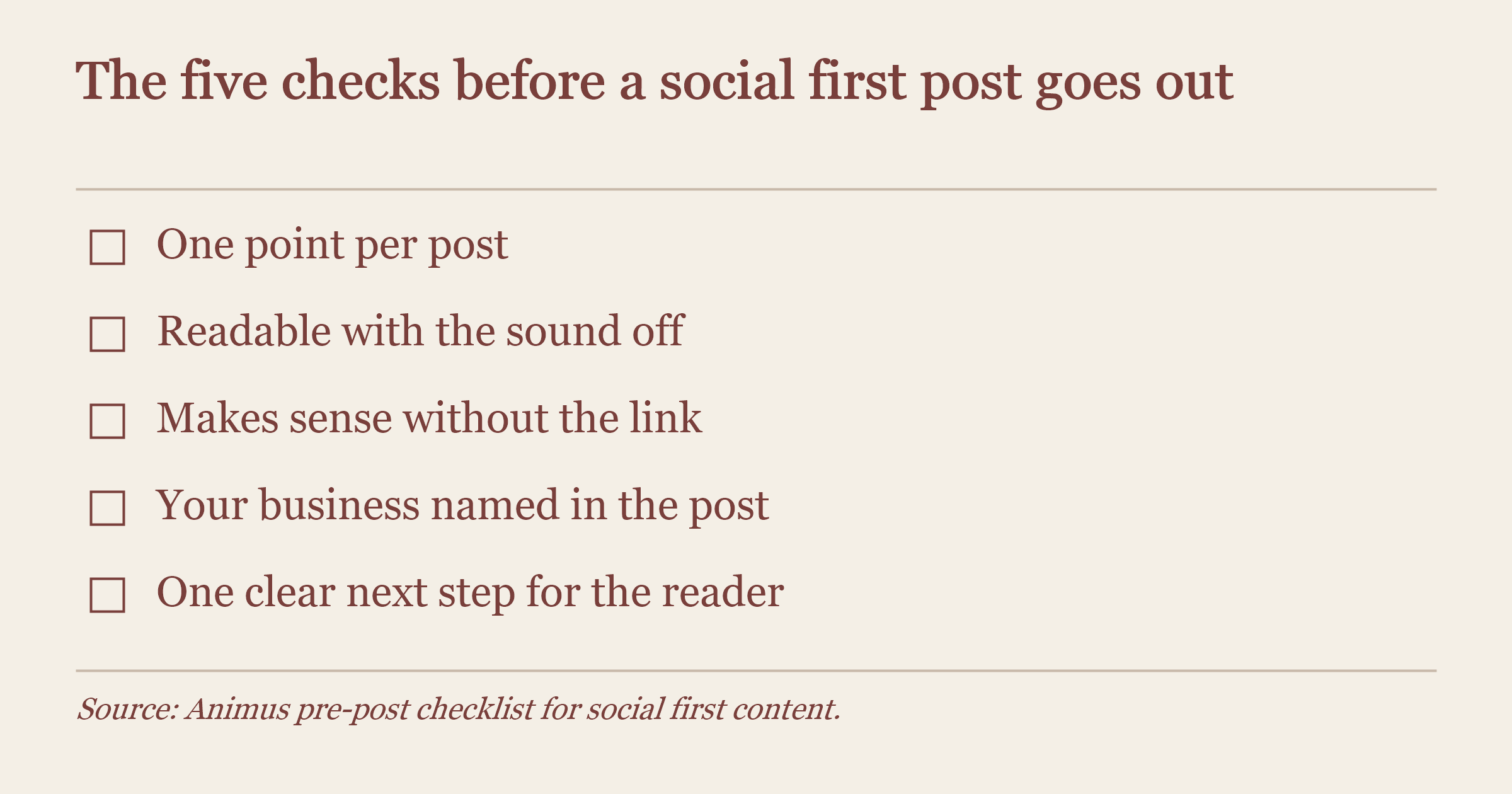
- One point per post
- Readable with the sound off
- Makes sense without the link
- Your business named in the post
- One clear next step for the reader
The sound check matters more than it looks. Someone scrolling in a waiting room or on a train may have the sound off, and a video whose point lives only in what you say out loud gives them nothing. Burned-in captions, or a first frame that states the point in text, keep the post working for that person.
Run the “understandable without the link” check first, because it catches the most common mistake. Read the caption with the link deleted. If the post now says nothing, the value is still on the website, and the post is a signpost.
What to measure when you post social first
Measure the actions that show a post was useful on its own: saves, shares, replies and messages that ask about the service. Likes tell you someone noticed. A save or a question tells you the post did its job.
I built a weekly reporting system for my own businesses and use the same one for clients. The discipline it enforces is looking at the same few measures every week, so a change shows up as a change rather than as a feeling. For social first posts, the useful weekly question is which posts produced a message or a booking enquiry, and what those posts had in common.
Clicks to the website are still worth watching, but treat them as a second signal. A social first post that earns a save and a message has worked even if nobody clicked. Our piece on marketing operations KPIs sets out how to choose measures that change a decision rather than fill a report.
Where social first content needs a system behind it
Social first content breaks down when it depends on someone remembering to take photos and write captions in a busy week. The posts themselves are simple. The hard part is doing it every week without it becoming the job that slips.
That is a readiness question, not a reason to stop. What has to be true is a capture habit on every job, a short set of rules for what a post must contain, and one person who owns the weekly review. The rules matter more than they sound: a post written to a clear rule set comes out consistent, and a post written from a vague instruction comes out generic, whoever or whatever writes it.
If you are doing this yourself, start with the capture habit and the five checks above. Our guide to what you can genuinely do yourself in digital marketing is a fair test of how much of the rest you want to keep in-house.
Want a social first content system that runs every week? Tell us the one workflow you want to hand over, and we will show you how the capture, the rules and the weekly review would run for your business. Book a strategy call.
Sources
- LinkedIn, “Three Principles for Effective B2B Video Brand Building”, 9 February 2026.
- W3C Web Accessibility Initiative, “Making Audio and Video Media Accessible”, updated 17 September 2024.