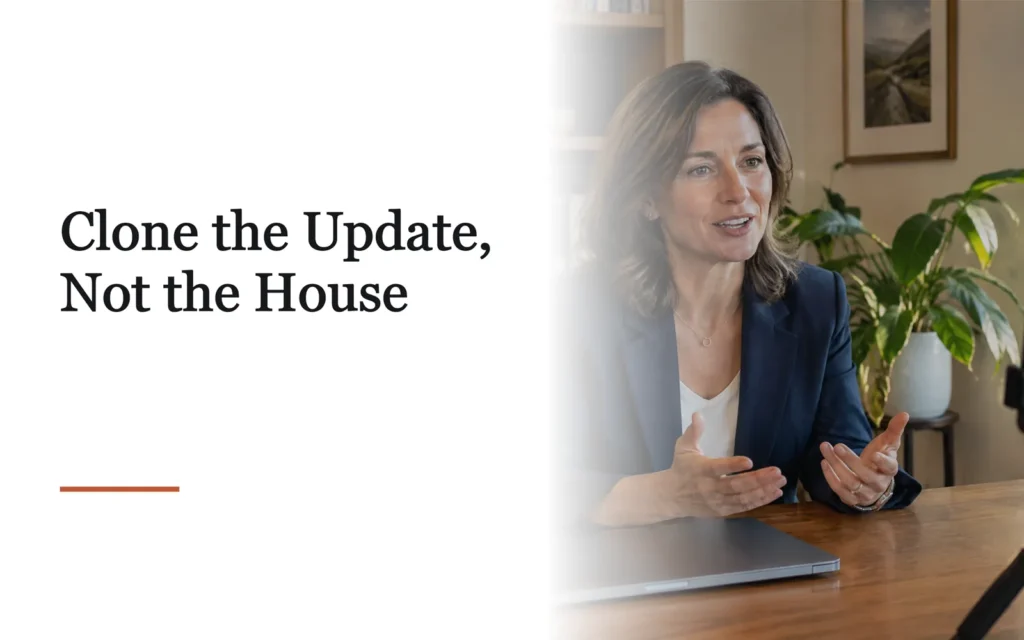
A HeyGen clone can take over the routine videos a real estate agent makes every week, such as market updates and agent introductions, from a typed script and without a camera. It cannot stand in for the house itself. Before you hand your face and voice to one, check three things: who has consented to the likeness, which videos honestly suit a clone, and how YouTube, Meta and the NAR Code of Ethics expect realistic AI video to be presented.
The idea is getting attention because of a YouTube video by Julia McCoy, founder of First Movers, which sells AI training and clone-building services, titled “How Real Estate Agents Use a HeyGen Clone to Never Film Again.” This guide sets out what that video and HeyGen itself claim, what still needs a real person, and what to disclose.
Want this built for you?
Animus Engine installs the marketing brain and the engine that runs on it. A human hand on every gate.
What the Clone Video Claims

McCoy’s video is narrated by her own clone, which she calls Dr. McCoy. In the video description she says the clone pulls more than 2 million impressions a month, and the same description credits her channel with more than 750 videos she never filmed. Those are the creator’s own figures, not independent measurements, and the description opens with an affiliate link to HeyGen, so treat the video as an enthusiast’s pitch rather than a review.
The useful part is concrete. The description gives three prompts for HeyGen’s Video Agent, each with blanks for the agent to fill:
- Market update: a 25-second vertical video for a city and ZIP code, with the avatar on camera, this week’s median price, days on market and active inventory shown as on-screen text, and one closing line on what the numbers mean for sellers.
- Listing tour: a 15-second vertical tour hosted by the avatar, built from the listing’s own photos, with one standout feature per room and the open house time at the end.
- Agent intro: a 25-second introduction from a pasted bio covering who the agent is, the neighborhoods they work and how they work with buyers and sellers.
The description also claims Video Agent “now turns one prompt and 15 seconds of phone footage into a finished listing video.” That is McCoy’s description of the product. HeyGen’s own Video Agent page says the tool writes the script, adds narration, edits, and produces motion graphics, overlays and B-roll footage around the avatar, and that every element stays editable after the video renders.
Tell Us the Task That Eats Your Week
Name one marketing job you’d hand off tomorrow. We’ll send back how we’d run it with AI — the steps, the tools, and where a human stays in charge. A real reply from Chris within one business day.
How a HeyGen Clone Gets Made
HeyGen calls a clone of a real person a custom avatar. Its product page says you record a short calibration video through a guided process, and HeyGen generates a digital version of you that speaks like you. The same page says HeyGen supports more than 40 languages.
Jerad Larkin, a sales executive with Chicago Title Colorado who teaches Denver agents about the tool, describes the setup in practical terms on his blog: record yourself speaking to the camera for two to five minutes, then type a script, choose the avatar and background, and generate. He says setup takes 30 to 60 minutes and that most generated videos are ready in under 10 minutes. Those are his estimates from teaching the tool, not HeyGen figures, and the time to write a good script comes on top.
The Person in the Avatar Has to Consent
HeyGen’s Acceptable Use and Moderation Policy requires “the explicit consent of the individual being represented” before anyone creates a custom avatar, and prohibits avatars of other people without it. The policy makes the account holder responsible for consent to every later use of the avatar, and it lets the person depicted ask for their likeness to be removed at any time. If they do, you are responsible for taking down the videos you published with it.
For a solo agent cloning themselves, that is simple. For a team or brokerage, it is a real decision. Get a teammate’s consent in writing before you build their avatar, agree what it will and will not be used for, and decide in advance what happens to their videos if they leave.
Three Videos an Agent Can Hand to a Clone

I built my own AI system to save time and work more efficiently. For an agent, the useful test for which videos to hand over is time: a video earns a clone only if the agent would otherwise spend real time filming the same format every week, and the facts in it can be checked before it posts.
Weekly Market Updates
A market update is the clearest fit. The format repeats, the script changes only in its numbers, and the numbers come from the agent’s own data. The risk is the numbers themselves: a clone reads whatever is in the script, so check every figure against its source before you generate, and say where the figures come from on screen or in the caption.
Agent Introductions
An introduction video is written once and reused, which makes it a good first test. Keep it to facts you can stand behind: your name, your brokerage, the neighborhoods you work and how you work with clients.
Listing Intros, Not Invented Tours
A clone can introduce a listing. It should not show the buyer anything the house does not have. Larkin’s own advice is to pair the avatar’s introduction with real footage for full walk-throughs. Build any tour from the listing’s actual photos or video, and do not let a tool add generated B-roll of rooms, views or finishes. YouTube lists “AI generated extra footage of a real place” among the examples that need disclosure, and a generated room can mislead a buyer about the property itself.
Consider a hypothetical solo agent in Phoenix who films a market update every Monday morning. Handing the update to a clone gives back that Monday hour. Handing the listing walk-through to generated footage would trade a few hours for a buyer who arrives at the showing expecting a kitchen that does not exist.
Where a Clone Fits and Where It Does Not
| Video | Clone fit | What still needs a real person or real footage |
|---|---|---|
| Weekly market update | Strong | Checking every figure and naming its source |
| Agent introduction | Strong | A bio you can stand behind, with your brokerage named |
| Listing intro | Good, with real media | The listing’s actual photos or video; no generated rooms or views |
| Full property tour | Weak | Real footage of the property |
| Reply to a specific client | Weak | You, on a call or in person |
The pattern is simple. A clone suits a video whose script is the whole message. It does not suit a video whose value is that the viewer is seeing a real place, or hearing from you personally.
What YouTube, Meta and the NAR Code Expect
A clone video makes a real person appear on camera saying words they typed rather than spoke. Platform rules and the profession’s own code both reach that case.
YouTube Requires an AI Disclosure for Realistic Video
YouTube requires creators to disclose AI-generated or altered content that seems realistic, including content that “makes a real person appear to say or do something they didn’t do.” Creators disclose it through the “AI use” setting in YouTube Studio during upload, and YouTube then labels the video as AI generated or altered. YouTube says disclosure alone will not limit a video’s audience or its eligibility to earn money. A realistic clone of you is the kind of content the rule describes, so switch the setting on.
Meta Labels AI Video It Detects or You Disclose
Meta adds an “AI info” label to video, audio and images on Facebook, Instagram and Threads when it detects industry-standard indicators of AI generation or when the person posting discloses it. In public opinion research Meta ran with more than 23,000 respondents in 13 countries, 82 percent favored warning labels for AI-generated content that depicts people saying things they did not say. That figure measures opinion about labels in general, not how buyers react to agent videos, but it suggests labelling a clone is unlikely to surprise viewers.
NAR Article 12 Asks for a True Picture
Article 12 of the National Association of Realtors Code of Ethics requires Realtors to “be honest and truthful in their real estate communications” and to “present a true picture in their advertising, marketing, and other representations.” Standard of Practice 12-5 also requires the name of the Realtor’s firm to appear in a reasonable and readily apparent manner in advertising. A clone video is still advertising: name your brokerage in it, and keep the property honest. The Code does not mention AI or avatars, so check your brokerage’s policy and your state’s advertising rules for licensees before your first clone video posts.
If you are deciding which platforms the videos belong on, our guide to social-first content covers how a small business earns attention in the feed, and our guide to AI marketing for small business explains how to start with one measurable workflow.
Thinking about a clone for your weekly videos? Tell us which videos you film now and how often, and we will help you choose the one format worth handing to a clone, with the checks and disclosure it needs before it posts. Book a strategy call.
Sources
- Julia McCoy (YouTube), “How Real Estate Agents Use a HeyGen Clone to Never Film Again” (video and description), accessed 22 October 2026.
- HeyGen, “AI Video Agent” product page, accessed 22 October 2026.
- HeyGen, Acceptable Use and Moderation Policy, accessed 22 October 2026.
- Jerad Larkin, Mile High Title Guy, “How Denver Real Estate Agents Can Use HeyGen to Create AI Avatar Videos”, accessed 22 October 2026.
- YouTube Help, “Disclosing use of GenAI content”, accessed 22 October 2026.
- Meta, “Our Approach to Labeling AI-Generated Content and Manipulated Media”, accessed 22 October 2026.
- National Association of Realtors, “2026 Code of Ethics and Standards of Practice”, accessed 22 October 2026.