
The Short Answer: Delegate Drafts, Not Professional Responsibility
AI marketing for law firms starts with one division of labour: a firm can hand AI the first draft of most marketing work. What it cannot hand over is the judgement about whether the resulting claim is true, whether the input was confidential, and whether a person searching for a lawyer is being misled.
Want this built for you?
Animus Engine installs the marketing brain and the engine that runs on it. A human hand on every gate.
That line is not a stylistic preference. Under the ABA Model Rules, a lawyer “shall not make a false or misleading communication about the lawyer or the lawyer’s services” — and a communication is false or misleading if it contains a material misrepresentation of fact or law, or omits a fact necessary to make the statement as a whole not materially misleading. The omission half is the one that catches generated copy, because a drafting tool optimising for persuasive marketing language has no idea which qualifier it just dropped.
So the useful question is not “should our firm use AI.” It is: for each marketing task, what may the machine do, who must approve it, what must never be pasted in, and which rule governs it? That is a table, and the rest of this page builds it.
Scope, stated plainly: everything below is written to the ABA Model Rules as a baseline. The Model Rules are a model. Your governing authority is your own jurisdiction’s rules, which differ, and nothing here is legal advice or a compliance opinion for any particular firm or state.
Tell Us the Task That Eats Your Week
Name one marketing job you’d hand off tomorrow. We’ll send back how we’d run it with AI — the steps, the tools, and where a human stays in charge. A real reply from Chris within one business day.
The Four Risks a Firm Has to Map First
A claim that is false, or true but misleading. The commentary to Rule 7.1 is blunt about the second case: a truthful statement is still misleading if there is a substantial likelihood it leads a reasonable person to a conclusion about the lawyer’s services for which there is no reasonable factual foundation. “We win” is the obvious failure. “Decades of combined experience” on a two-lawyer firm is the subtle one.
Confidential information entering a tool. ABA Formal Opinion 512, issued in July 2024, applies the existing duties to generative AI directly: a lawyer must remain cognisant of the duty to keep confidential all information relating to the representation of a client, regardless of its source, absent informed consent. A marketing task feels far from the client file right up until someone pastes in a matter description to make a case study read better.
The supervision boundary. Opinion 512 is explicit that lawyers may not leave it to AI tools alone to offer legal advice, negotiate claims, or perform other functions requiring a lawyer’s personal judgement. In marketing, this bites at intake: acknowledging an enquiry and routing it is administrative; answering the substance of it is not.
Responsibility for content you did not write. Rule 7.2 requires that any communication made under it include the name and contact information of at least one lawyer or law firm responsible for its content. Automation does not create a category of firm communication that nobody owns.
The Law-Firm Marketing Delegation Matrix
The hub this page sits under sets out the general rule for splitting marketing work between machine and human. This is that split re-derived for a practice where being wrong has a regulator attached.
What to Delegate, Who Approves It, and What Never Goes In
| Marketing task | Safe AI role | Human gate | Never put in the tool | Primary source to check | Failure cost |
|---|---|---|---|---|---|
| Practice-area page copy | Full first draft from an approved brief | Lawyer verifies every claim about services, outcomes and specialisation | Client or prospective-client facts | Rule 7.1; your state’s rules on specialisation claims | Misleading advertising exposure |
| Blog and explainer posts | Full first draft; outline; restructuring | Lawyer reviews for legal accuracy and unintended advice | Matter details, even anonymised | Rule 7.1 | Inaccurate legal content published in the firm’s name |
| Meta descriptions, alt text, internal links | Draft and spot-check | Skim by a marketer; no lawyer needed unless a claim appears | Nothing sensitive arises here | — | Low; cheap to be wrong |
| Case studies and results | No draft role until the underlying facts are cleared | Named lawyer confirms accuracy and client consent on record | Anything not already cleared for public use | Rule 7.1; confidentiality duty per Opinion 512 | Confidentiality breach; misleading-results claim |
| Testimonials and reviews | Formatting and layout only | Lawyer confirms consent and that no endorsement rule is breached | Client identity not cleared for publication | Rule 7.1; Rule 7.2 on recommendations | Consent and endorsement exposure |
| Ad copy | Draft variants | Lawyer approves the claim set before launch; responsibility attribution present | Client facts; unverified outcome figures | Rules 7.1 and 7.2 | Misleading advertising at scale, paid for |
| Review replies | Draft a neutral acknowledgement only | Lawyer approves every word before it posts | Any detail confirming the reviewer is or was a client | Rule 7.1; confidentiality duty | Confirming a representation in public |
| Intake acknowledgement and routing | Acknowledge receipt; collect contact details; route | Defined escalation to a human; no substantive answers | — | Opinion 512 on the supervision boundary | Unsupervised legal communication |
| Substantive answers to a prospect’s legal question | None | Lawyer, always | — | Opinion 512 | Advice without a lawyer’s judgement |
| Newsletters and one-asset-to-many-formats | Full draft and reformatting | Same review as the underlying asset | Whatever was excluded from the original | Rule 7.1 | Inherits the source asset’s risk |
Two rows are worth reading twice. Case studies and results is where most firms want AI help and where it is least available — not because a machine drafts them badly, but because the input is the problem. Review replies looks trivial and is the single easiest way to confirm publicly that someone was your client.
The Canon the Tool Needs Before the First Draft
None of the above works if the tool is guessing about your firm. Before any drafting begins, write down — in one document the tool is given every time — the material it must not invent:
- the services the firm actually offers, and the ones it does not
- the jurisdictions where its lawyers are admitted
- how the firm is permitted to describe specialisation under its own state’s rules
- claims that are approved, and the specific ones that are banned
- whether testimonials may be used at all, and which have consent on record
- the firm’s voice: how it refers to clients, prospects, and outcomes
This is the same canon-first discipline the hub describes, with the difference that here several of the entries are regulatory rather than editorial. A firm that skips this step is not saving time; it is moving the work from drafting to correction, where it is slower and easier to miss.
The Human Gates That Do Not Disappear
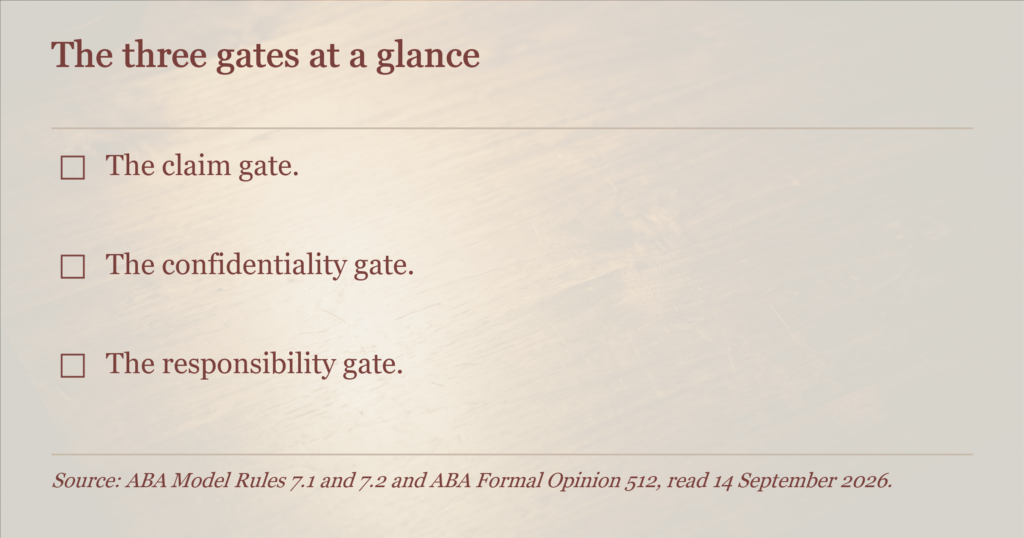
Three gates survive any amount of automation:
The claim gate. Every statement about services, outcomes, experience or specialisation is verified by a named lawyer before it is published. Not “reviewed” — verified against something.
The confidentiality gate. Nothing relating to a representation goes into a tool unless the firm has satisfied itself, under its own policies and obligations, that the specific tool and data path permit it. This is a decision about a particular product, not about AI in general, and Opinion 512’s duty attaches regardless of where the information came from.
The responsibility gate. Every published communication has a named lawyer or firm accountable for its content, per Rule 7.2. If you cannot say who owns a page, it is not ready.
A useful test for whether a gate is real: can you name the person, and would they know they hold it? A gate assigned to “the team” is not a gate.
The Three Gates at a Glance
A Thirty-Day, One-Workflow Pilot
Do not roll this out across marketing. Take one low-stakes workflow and run it properly.
- Week 1. Write the canon above. Pick the workflow — blog drafts or meta descriptions are good first choices; case studies and intake are not.
- Week 2. Run drafts through it. Name the reviewer before the first draft exists, not after. Log what was generated, who approved it, and what they changed.
- Week 3. Read the change log. If the reviewer is rewriting substantially every time, the canon is thin, not the tool. Fix the canon.
- Week 4. Decide: keep, extend to one adjacent task, or stop. Write the decision and the reason down.
The change log is the point. After four weeks you will know how much lawyer time the workflow actually consumes, which is the only honest basis for deciding whether it saved anything.
From Canon to a Reviewed Draft

Questions to Ask an AI Marketing Vendor
- Who reviews claims about our services before anything publishes, and are they a lawyer?
- What exactly is sent to the model, and where is it processed and retained?
- Will any client or prospective-client information be included — and if the answer is “only anonymised,” what is the anonymisation, precisely?
- Which of our state’s advertising rules have you read?
- Who is named as responsible for the content under Rule 7.2?
- What do you log, and can we see it?
- If a published claim turns out to be misleading, what is your process?
A vendor who answers the first and third questions cleanly is worth more than one with better output samples.
When the Honest Answer Is to Buy Nothing Yet
- Your firm has no written canon. Buying a drafting tool first means generating faster from an unstated position. Write the canon; you will need it whether or not you buy anything.
- No named lawyer has capacity to review output. AI shifts effort from drafting to reviewing. If nobody has the hours to review, the tool creates unreviewed publications, which is worse than a slower marketing calendar.
- You cannot yet say what goes into the tool. Until the confidentiality question is answered for the specific product and data path, the safe scope is “nothing relating to any representation,” and much of the appeal disappears.
- The only tasks you actually want help with are the gated ones. If what you want is AI-written case studies and intake responses, the answer is no, and it does not change with a better tool.
- Your state’s rules differ from the ABA baseline in ways nobody has checked. That check is cheap and comes first.
Stopping here costs you nothing but time. None of these conditions are permanent, and the canon work is the same work you would do before any marketing investment.
What to Do This Quarter
- Read your state’s advertising and solicitation rules — the actual rules, not a summary.
- Write the canon. One document, all six items.
- Pick one low-stakes workflow and name its reviewer.
- Answer the confidentiality question for the specific tool you are considering.
- Run thirty days with a change log.
- Decide on the log, not on the demo.
If you want senior marketing judgement on a part-time cadence rather than a full-time hire, that is what our fractional Chief Marketing Officer engagement is. If you would rather talk through one workflow first, book a thirty-minute call. Founder-operated. Limited client intake.