
AI Overviews traffic became a measurable business question when Google attached a traffic promise to the feature. On 14 May 2024, when AI Overviews began rolling out to everyone in the U.S., Google said the links included in them get more clicks than the same page would get as a traditional listing for that query. Search Console can now isolate generative-search impressions, but it still combines clicks from AI features with ordinary web search totals.
That sentence is worth reading as a claim to measure rather than a forecast to repeat. It was made by the company that runs the results page, about its own feature, and it described what Google said it saw in its own data. Whether it holds for your pages is a separate question, and it is one only your own numbers can answer.
Want this built for you?
Animus Engine installs the marketing brain and the engine that runs on it. A human hand on every gate.
What Google Promised When AI Overviews Launched in 2024
Google’s launch post made four statements about AI Overviews and traffic, and each one is Google describing its own product. Elizabeth Reid, Google’s vice president of Search, wrote the announcement on the Google blog, dated 14 May 2024.
The Four Traffic Statements in Google’s May 2024 AI Overviews Announcement
| What Google said | What kind of statement it is |
|---|---|
| AI Overviews would begin rolling out to everyone in the U.S. that day, giving hundreds of millions of users access that week | A launch fact about Google’s own product |
| Google expected to bring AI Overviews to over a billion people by the end of 2024 | A forecast, dated May 2024 |
| Links included in AI Overviews get more clicks than if the page had appeared as a traditional web listing for that query | A measurement claim, with no figure or method published in the post |
| Google would “continue to focus on sending valuable traffic to publishers and creators” | A stated intention |
Only the third row is a claim about what happens to a website’s clicks, and it is the one that matters to you. The post gives no figure and no method for it. That does not make it false. It means the post gives you nothing to check it against.
Tell Us the Task That Eats Your Week
Name one marketing job you’d hand off tomorrow. We’ll send back how we’d run it with AI — the steps, the tools, and where a human stays in charge. A real reply from Chris within one business day.
What Search Console Can and Cannot Show About AI Overviews
Search Console now has a dedicated generative AI performance report for AI Overviews and AI Mode. It shows impressions with breakdowns by page, country, device, and date. That lets you identify which pages receive generative-search visibility and whether the visibility changes over time.
The dedicated report does not provide clicks. Google’s AI features documentation says clicks from AI Overviews and AI Mode are counted inside overall search traffic in the Performance report under the “Web” search type. A click from an AI Overview and a click from an ordinary blue link therefore land in the same total. You can see that clicks for a page rose or fell, but that report alone cannot tell you how much of the change came from AI Overviews.
The two reports answer different questions. Generative AI impressions show whether Google selected a page for an AI-assisted result. Web search clicks show whether total organic visits changed. Analytics shows whether those visits produced inquiries, sales, or another useful action. No single metric completes the chain, and a change in one does not automatically explain a change in another.
For an owner, the useful unit is a stable group of pages with the same business purpose. Put service pages, comparison pages, and educational articles in separate cohorts. A sitewide total can hide a gain in one group behind a decline in another. Page-level cohorts also make the next decision concrete: maintain the page, improve it, or stop investing in that topic.
Google also says AI Overviews appear only when its systems judge them to add something beyond classic Search. A query that sends you traffic may never show an AI Overview, which makes a broad before-and-after comparison noisier than it looks.
How to Test the AI Overviews Traffic Promise on Your Own Site
A fair test compares the same pages and the same kinds of queries across two periods, and it treats any change as a lead to investigate rather than proof. None of it needs a paid tool. It does need a site that is already set up in Search Console. Keep the first cohort narrow enough to read, preserve each export, and note promotions, site changes, or ranking shifts that could explain the result.
- Pick the pages that bring you customers, not every page on the site.
- Compare generative AI impressions and total Web search clicks for those pages across two equal periods, a year apart where you can.
- Note which queries changed, since Google says AI Overviews show only where they add something to classic Search.
- Check whether visits from search still turn into inquiries or sales, not only whether clicks moved.

The third step needs care. Google’s launch post tied AI Overviews to more complex questions, and its documentation says they often do not appear at all. A drop concentrated on simple, factual queries tells you something different from a drop spread evenly across every query.
“Higher Quality” Clicks Are Google’s Measure, Not Yours
Google’s documentation says clicks from results pages with AI Overviews are “higher quality”, and it defines that as people being more likely to spend more time on the site. Time on site is a reasonable signal. It is not the same as an inquiry or a sale, and for a small business those are the numbers that pay.
The same page suggests tracking conversions and time spent in tools such as Google Analytics alongside Search Console. That is the useful instruction in it. If fewer clicks arrive but more of them turn into inquiries, the traffic change may cost you nothing. If clicks hold steady and inquiries fall, the reassuring claim in the launch post does not describe your site.
Where a Person Still Reads the Numbers
Reports can collect the numbers automatically, but someone who knows the business has to decide what a change means. This is the order we would read them in each month.
- Pull clicks and impressions for the pages that bring customers.
- Set them beside the same period a year earlier.
- Check the change against inquiries and sales from search.
- Decide whether a page needs work, and write down why.
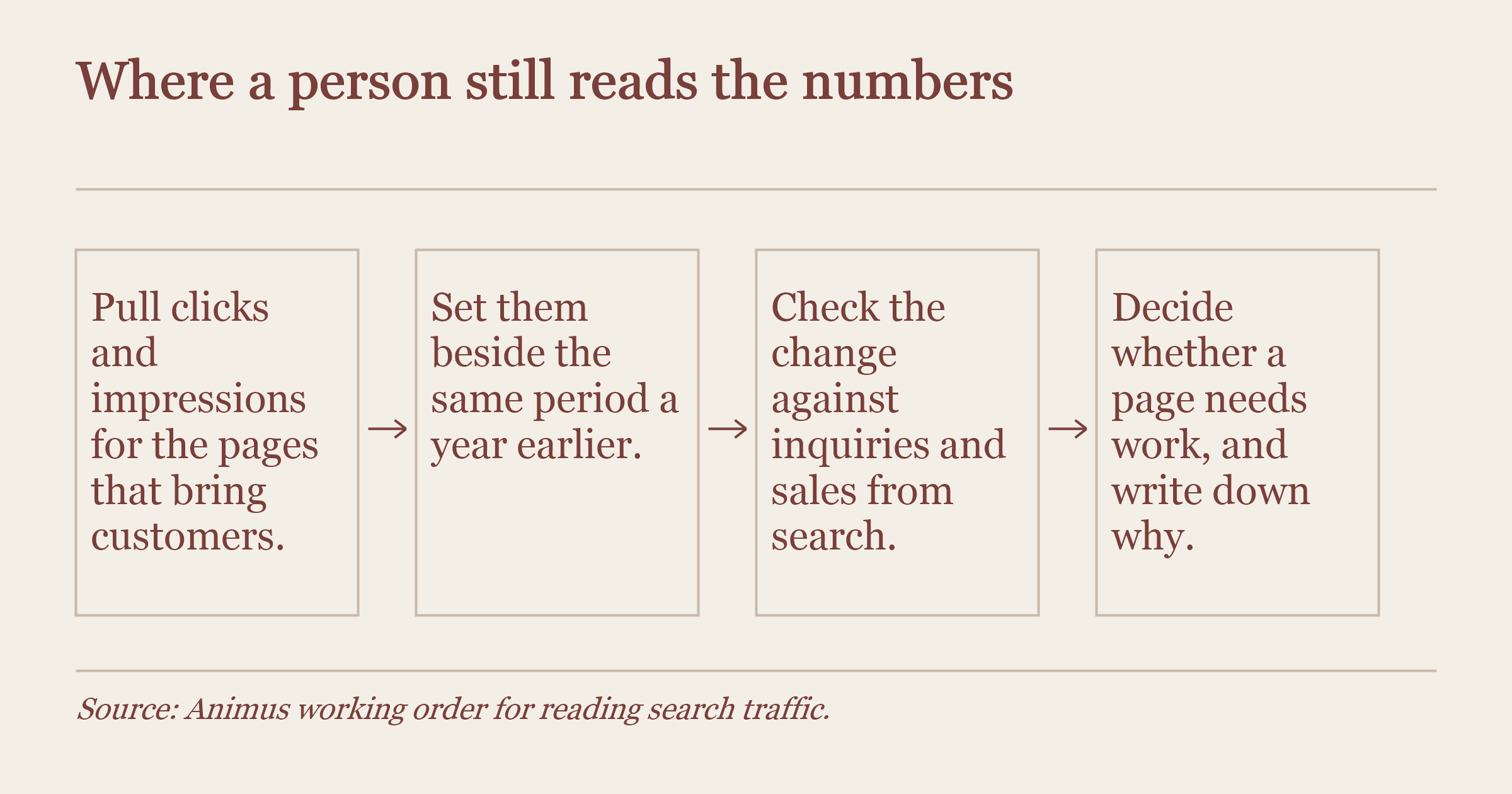
The last step is the easiest one to skip. A written reason gives you something to check the following month, which is how a vendor’s claim becomes your own evidence over time.
What to Do With the Next Traffic Promise
Read a platform’s traffic claim for what it tells you to measure, then measure it on your own pages. Google’s 2024 statement tells you where to look: the clicks on pages that appear in AI Overviews. Its own documentation tells you that your reports will not separate those clicks out for you. We looked at the wider question of what search work returns in is SEO worth it.
Next step: pull a year of clicks for the pages that bring you customers, then book a strategy call and bring the numbers.