
AI risk for small business is a reversibility decision you can make this week, even after I read all 60 comments on the 16 September 2026 Hacker News thread. The post is item 49729849, titled “Ask HN: AI Panic, you buying it?”, submitted at 17:00 UTC, asking whether the panic is real or a marketing ploy. I opened it on 18 September 2026, when it had 29 points and had not converged. Sort each workflow by whether a wrong output can be undone. That sort does not wait on who is right.
Want this built for you?
Animus Engine installs the marketing brain and the engine that runs on it. A human hand on every gate.
What the Argument Actually Looked Like
The 16 September 2026 Ask HN thread never converged, and none of its camps names a Monday action for a small business.
I read the whole thread rather than the headline. The post is “Ask HN: AI Panic, you buying it?”, submitted 16 September 2026 at 17:00 UTC. When I read it on 18 September 2026 it carried 29 points and 60 comments.
The first camp treats the alarm as commercial. One reply is eight words long: “No, just a push for regulatory capture, nothing more.” A longer version makes the mechanism explicit — “Frontier AI companies need the government to shield them from becoming commodity. That’s why they’re begging for regulation.”
The second camp accepts real harm but rejects the extinction framing. One commenter writes that “The damage AI is causing to society is real and happening now” and that potential doomsday scenarios are a distraction from it. Another puts the distinction this way: “I’m not saying that genAI is harmless and the dangers can be ignored. I’m just saying that the dangers of the tool don’t rise to the level of human extinction.”
The third camp is open uncertainty. The top reply declines a yes-or-no answer, argues that the truth sits somewhere on a continuum nobody has located, and finishes: “the data needed to do that just isn’t there.”
Those positions are about vendor motives, or about the odds facing humanity. They are not about your inventory of workflows, and they do not tell you which step can run unattended.
Tell Us the Task That Eats Your Week
Name one marketing job you’d hand off tomorrow. We’ll send back how we’d run it with AI — the steps, the tools, and where a human stays in charge. A real reply from Chris within one business day.
Why Waiting for the Argument to Resolve Is Not a Strategy
The disagreement will not close on a timetable that suits a planning cycle, and the vendors themselves say so in writing.
Anthropic’s threat intelligence report of September 2026 — cited inside the thread by a commenter arguing the risk is genuine — describes its own evaluations of biological misuse capability and then concedes the limit of them. Older models sat “well below the threshold” where they could meaningfully assist a sophisticated user. For current models, the report states, “the evidence is no longer certain, and we cannot make that same assurance.”
That is a company publishing, about its own product, that it does not know. You are not going to out-research that position, and neither is anyone selling to you.
Certainty about AI capability is unavailable at any price. The ability to undo a bad output is a design decision you control, and what it costs is a review step.
Sort Each Workflow by Whether You Can Undo It
Replace the global question with one answerable question per workflow: if this step produces a wrong output, who finds out, how fast, and what does it take to undo?
That sorts every AI-assisted step you run into tiers, and the tier decides the control.
- Reversible and visible. A draft email, a first-pass social caption, a summary you read before acting. A wrong output is caught by the person already reading it. Automate freely.
- Reversible but invisible. Bulk product descriptions, meta descriptions across two hundred pages, an automated reply nobody reviews. The error is undoable, but it can run for weeks before anyone notices. These need sampling and an alert, not a gate.
- Irreversible. Anything that sends to your list, changes a published price, files something, or speaks to a customer as you. A gate goes in front of the action, with a named person behind it.

The tiers do not require an opinion about artificial general intelligence. They require you to know which of your steps can be taken back.
Controls That Hold on Either Reading of the Thread
The same controls still apply if the alarm is a marketing ploy and if it is not.
A named owner for every automated workflow. Put one person’s name on the workflow. Unowned automation is a common failure mode, and it is the same gap that lets a broken contact form sit unnoticed for a month.
The review step in front of the irreversible action. Most businesses install review where it is convenient rather than where the damage happens. Move it to the last point at which the output can still be stopped.
A written list of what you never delegate. Put it on paper before anyone asks for an exception. Ours includes client numbers, testimonials and anything said in a founder’s voice. Yours will differ, and it should be short enough to remember.
One commenter in the thread put the underlying principle better than most vendor documentation manages: “Everything magic about LLMs is what harness we put them in and let them drive.” The harness is the part you own.
The Y2K Comparison, and What It Actually Proves
One Hacker News reply cites Y2K’s quiet outcome and then names the prep work as the reason nothing appeared to happen.
The comment reaches for dire warnings, planes falling out of the sky, and in the end “nothing happened”. It then supplies the correction most people skip: “You could argue that’s because of the prep work people put into avoiding that.”
The comment names the prep work as the reason the quiet outcome arrived. If you treat “nothing happened last time” as your risk model, you are citing the preparation while skipping it.
Who Is Not a Neutral Narrator of Your Risk
The 16 September 2026 thread is more useful as a map of who is talking their own book than as a verdict on extinction.
One commenter names it directly: the more immediate concern is “the efforts of frontier labs to have government craft legislation that shields them from competition, cements them as monopolies, or assigns them the capability to be moral arbiters in our society.”
Another reply refuses the forced choice — “Both. Two things can be true at the same time.” A risk can be real and its loudest messenger can still be talking its own book.
Apply that consistently and it points at this publication too. An agency that sells AI-assisted marketing has an interest in you feeling both excited and slightly afraid. I think governed autonomy, where automation runs inside controls you can name, is the correct posture, and you should still weigh it knowing who is saying it.
What I Did Not Verify
Comment-only incident reports in the thread stay unverified, and the forecasting document one reply named is AI 2027.
Several commenters referred to recent incidents as established fact, including a security breach at a model hosting company and a mathematical result attributed to a frontier model. Those references sit inside comments. I did not resolve them to primary sources, and I am not repeating them as fact here.
On 16 September 2026 at 19:45 UTC, comment 49731933 by BatFastard recommended AI 2027 and wrote, “This prediction has proven quite accurate so far.” The original drafting run confirmed that page returned HTTP 200 on 18 September 2026. I did not audit the forecast against later events, and I do not endorse it.
I am saying this out loud because the same standard is the one to apply to any vendor briefing you receive. A claim is worth what its source is worth, and “someone credible said it in a thread” is not a source.
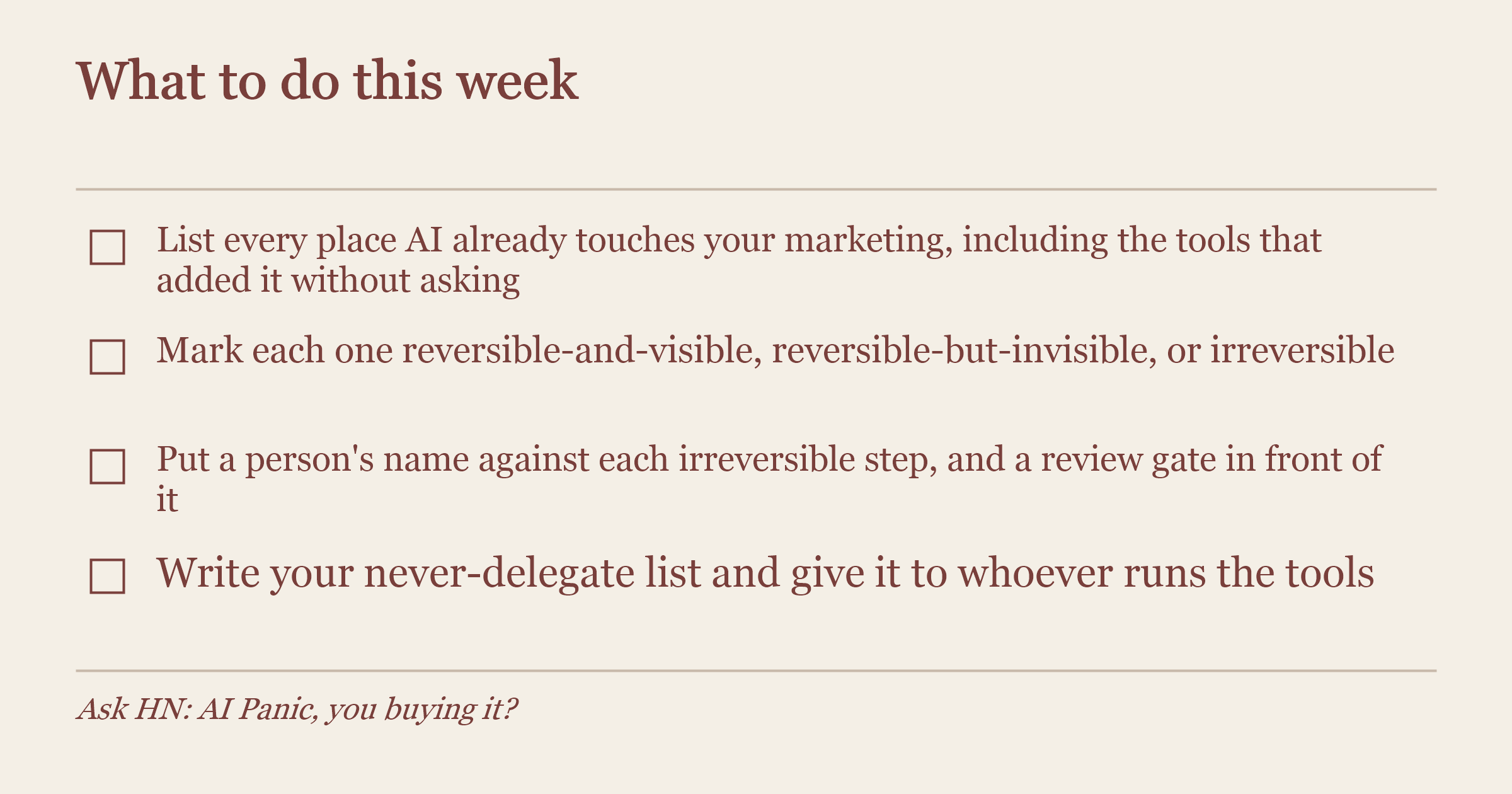
What to Do This Week
These four steps do not require you to resolve the argument, and they still stand if you are wrong about it.
- List every place AI already touches your marketing, including the tools that added it without asking
- Mark each one reversible-and-visible, reversible-but-invisible, or irreversible
- Put a person’s name against each irreversible step, and a review gate in front of it
- Write your never-delegate list and give it to whoever runs the tools
The adjacent playbooks are already written. Build the system before you buy the tool covers how to choose what to automate first, and the controls that matter before you publish cover the publishing gate specifically. This piece is the layer above both — the posture you hold while the people who build these systems are still arguing about what they are.
If you want a second pair of eyes on which AI steps in your marketing can run unattended and which need a gate, that is a conversation rather than a demo. Book a strategy call.