
There is no normal price for a digital marketing agency, and the useful response to that is not to keep hunting for one. It is to stop comparing quotes on their totals and start comparing them on what each one actually commits to doing. Three agencies quoting three very different numbers are usually not disagreeing about price at all. They are quoting three different jobs, and only one of them has told you which.
This post is the method we use to put quotes into the same shape so they can be read side by side. It contains no benchmark figure, no average retainer and no price band, and the reason for that is the first section.
Want this built for you?
Animus Engine installs the marketing brain and the engine that runs on it. A human hand on every gate.
Why There Is No Normal Price for a Digital Marketing Agency
Because the thing being priced is not a defined unit. A quote for a kitchen fitting describes a kitchen. A quote for digital marketing describes whatever that agency decided to put inside the word, and the contents move by an order of magnitude between one proposal and the next without either of them being dishonest about it.
You will find pricing benchmarks published anyway. Treat them carefully, because almost all of them share three defects. They are self-reported by the agencies who chose to answer. They rarely state what was inside the scope being priced. And they describe the engagements that survived long enough to be reported, which is a filter that quietly removes the ones that went wrong. A number assembled that way is not evidence about what your engagement should cost.
We are not going to publish our own benchmark to replace them. We would have to assemble it from the same class of material, and a figure we invented would be worse than the gap it filled, because it would carry our name on it.
What you can do instead is make the quotes comparable. That is entirely within your control, it costs nothing, and it is the whole job.
Tell Us the Task That Eats Your Week
Name one marketing job you’d hand off tomorrow. We’ll send back how we’d run it with AI — the steps, the tools, and where a human stays in charge. A real reply from Chris within one business day.
What You Are Actually Buying When You Buy Marketing Management
Before you can price the work you have to name it, and there is a neutral inventory of what this work consists of that nobody in the sales conversation wrote.
The U.S. Department of Labor’s occupational description for Marketing Managers names the core activities concretely rather than in the language of a proposal: formulating and coordinating marketing activities or policies; using sales forecasting or strategic planning to ensure the sale and profitability of products or services; identifying, developing or evaluating marketing strategy from establishment objectives, market characteristics and cost and markup factors; and directing the hiring, training and performance evaluation of marketing or sales staff. The page was updated in 2026.
Read a proposal against that list and the gaps show up immediately. Most agency quotes cover the second and third activities in part, cover the first only for the channels they happen to run, and do not touch the fourth at all. That is not a criticism. It is a scope, and it is the scope you are paying for. The problem only starts when a quote that covers a third of the function is compared against one that covers most of it, on price.
The same source carries the one comparison figure in this article that comes from a primary, official record rather than from a survey of vendors. It reports median wages for marketing managers in 2025 of $80.19 hourly and $166,790 annual, attributed to the Bureau of Labor Statistics. Two cautions before you use it. That figure is for marketing managers as an occupation, not for advertising and promotions managers, who are a separate group with different pay. And it is a salary for one employed person, not a price for an agency, which is buying you a team’s partial attention instead of one person’s whole week. It is a reference point for the cost of the function, and nothing more than that.
Normalise the Quotes Before You Compare Them
Put every quote through the same six columns before you look at any total. The exercise usually reorders your shortlist on its own.
The Six Columns
| Column | What you are extracting | What a vague answer means |
|---|---|---|
| Deliverables per month | Countable outputs, with quantities | The quantity is the agency’s to set later |
| Who does the work | Named seniority, not a team photo | The person who sold it is not the person doing it |
| Hours or capacity | A stated ceiling, however rough | There is a ceiling and you will meet it in month three |
| What is billed extra | Ad spend, tools, licences, production | The quote is a floor, not a price |
| Reporting | Cadence, format, and who reads it aloud | Reporting is a dashboard you will stop opening |
| Exit | Notice period and what you keep | The cost of leaving is part of the price |
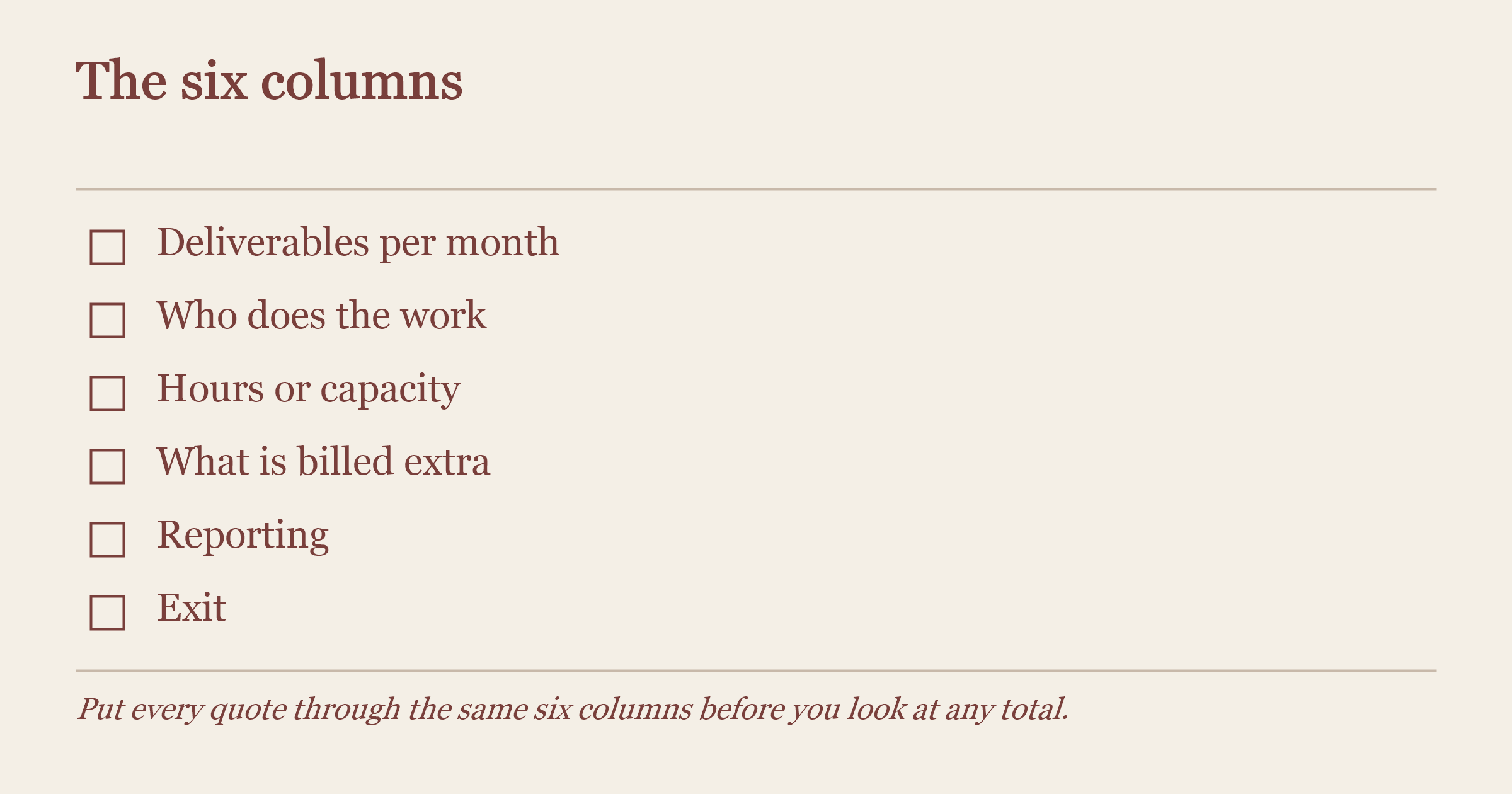
Two of those columns do most of the work. What is billed extra is where two quotes that looked a year apart turn out to be neighbours, or the reverse. And exit is the one nobody asks about while they are still optimistic, which is exactly why it is where the unpleasant surprises live. Ask who owns the ad accounts, the tracking setup, the creative files and the audience lists on the day you leave. An agency that cannot answer that quickly has told you something.
The Five Questions That Turn a Number Into a Scope
Ask all five of every agency, in the same words, and write the answers down while they are talking.
- What is the smallest version of this you would still take on? The answer tells you what the agency considers load-bearing and what was padding. It also gives you a real lower bound instead of a guessed one.
- Which line here would you cut first if I halved the budget? An agency that cuts strategy first and keeps the output volume is selling you output. That may be what you want. Know which you are buying.
- Who will be in the room in month six? Named people, named seniority. Pitch teams and delivery teams diverge, and the divergence is the single most common cause of a relationship going quiet.
- What have you stopped doing for a client because it was not working? This is the honesty test. Any agency with a real practice has killed something. An agency that has never stopped anything either has no feedback loop or will not tell you about it.
- What would make you tell me not to hire you? The disqualifying answer is that there is nothing. We hold ourselves to this one too, which is why we published the questions that disqualify us rather than only the ones we pass.

What No Quote Can Promise, in Google’s Own Words
Any quote whose price is justified by a promised ranking is priced on something the seller does not control, and the party that owns the surface says so in its own documentation.
Google’s Search Central documentation describes search as three stages, crawling, indexing and serving, and states that not all pages make it through each stage. It then says, verbatim: “Google doesn’t guarantee that it will crawl, index, or serve your page, even if your page follows the Google Search Essentials.”
That is the platform operator, in its own reference material, declining to guarantee the outcome. It follows that no agency can guarantee it either, and the guarantee is not the only tell. A quote priced against a promised position, a promised traffic figure or a promised timeline to page one is a quote whose central commitment sits outside the seller’s control. What an agency can legitimately commit to is the work: what gets produced, at what cadence, by whom, and what will be reported. Price that, and you are pricing something a contract can actually hold.
The same logic applies in reverse to the cheapest quote in the pile. A low price alongside a confident outcome promise is not a bargain. It is two warnings arriving together.
How to Choose When the Numbers Still Disagree
Once the quotes are normalised they will still differ, and at that point the decision stops being arithmetic. Three rules we would apply.
Buy the smallest honest scope, not the lowest number. A scope you can evaluate in one quarter is worth more than a larger one you cannot read, because the thing you are really buying in the first engagement is information about whether this works for you.
Price the internal cost too. Every agency engagement consumes someone’s time on your side: approvals, briefings, access, the meeting. If nobody on your team has that time, the quote is not the price, and the shortfall usually shows up as a stalled engagement that gets blamed on the agency.
Decide your evidence in advance. Write down now what you will accept at ninety days as a sign this is working, and put it where you will find it. Deciding that after the first report is how an engagement renews on relief rather than on results.
If the normalisation exercise keeps returning quotes larger than the job, the comparison you want may not be between agencies at all. We have written up what a budget actually buys from an agency against a freelancer, and, one step earlier, how to tell whether you need an agency before you take the call.
What to Do This Week
- Take the quotes you already have and fill in the six columns. Leave blanks where the quote does not say, and do not fill a blank with a guess.
- Send the blanks back to each agency as questions. How fast and how specifically each one answers is itself a data point about the next twelve months.
- Ask all five questions of every agency, in the same words, and write the answers down during the call rather than afterwards.
- Write your ninety-day evidence standard before you sign anything.
- Check the exit terms last, and read them first at renewal.
None of this produces a normal price, because there is not one. It produces something more useful: three quotes you can actually read against each other, and a decision you can explain to yourself in six months.