
The highest score on OpenAI’s own chart for business workflows is 33.2%. That is GPT-6 Sol, one of two models OpenAI released on 22 September 2026, measured on AutomationBench, a test of end-to-end workflows across 47 tools in sales, marketing, operations, support, finance and HR.
GPT-6 Sol and GPT-6 Luna are real improvements, and paying ChatGPT users can use both today. The same announcement also shows how far the best model still is from running a business workflow on its own. For a small business using AI in its marketing, both facts matter.
Want this built for you?
Animus Engine installs the marketing brain and the engine that runs on it. A human hand on every gate.
What OpenAI Released on 22 September 2026
OpenAI released two new models, GPT-6 Sol and GPT-6 Luna, trained with similar methods to GPT-6 Astra, the model it introduced earlier in September. OpenAI’s announcement describes Astra as its best model across the board, and positions Sol and Luna as faster models that cost less to run.
The Three GPT-6 Models and Who Can Use Them in ChatGPT
| Model | How OpenAI positions it | Availability stated in the 22 September announcement |
|---|---|---|
| GPT-6 Astra | Its best model across the board, for the most demanding projects | Introduced earlier in September; not restated in this announcement |
| GPT-6 Sol | Difficult work tasks, with higher usage limits and lower cost | ChatGPT Work and Codex for Plus, Pro, Business, Enterprise and Edu users; the API as gpt-6-sol |
| GPT-6 Luna | The lower-cost of the two new models | The same paid plans; Free and Go users in the desktop app; the API as gpt-6-luna |
OpenAI says the models are not yet available in Chat and were rolling out through the day on 22 September, so a paying user may need to check the model picker rather than assume the switch has happened. OpenAI also cut the API prices for both models. We do not repeat the prices here: they change, and they apply to the API rather than to a ChatGPT plan.
Tell Us the Task That Eats Your Week
Name one marketing job you’d hand off tomorrow. We’ll send back how we’d run it with AI — the steps, the tools, and where a human stays in charge. A real reply from Chris within one business day.
The Figures OpenAI Published, and What They Measure
OpenAI ran its own models on the tests it reports, and took competitor scores from public reports. The figures below are the ones most relevant to marketing work, set out with the limits OpenAI’s own notes give them.
Figures From OpenAI’s 22 September 2026 GPT-6 Sol and Luna Announcement, With Their Limits
| Figure | What it measures | Whose measurement | What it is not |
|---|---|---|---|
| 33.2% | GPT-6 Sol’s score on AutomationBench, at its highest effort setting | OpenAI, on Zapier’s AutomationBench 1.0.6 | A completion rate for your own workflows |
| 30.3% | GPT-6 Astra’s score on the same test, at low effort | OpenAI, same test | Astra at its full effort setting |
| About half as many mistakes | GPT-6 Sol against its predecessor on OpenAI’s internal factuality test | OpenAI, on conversations where users had flagged an error | A measure of typical use, where OpenAI says errors are rarer |
The factuality row is the one to read carefully. OpenAI built that test from conversations where a user had already caught a factual mistake, so the test is deliberately hard. A model that makes half as many mistakes on hard questions still makes some, so a marketing claim still needs checking against your own records.
AutomationBench is Zapier’s benchmark for AI agents working across business apps. A top score of 33.2% is useful context. In our reading, the best result on OpenAI’s chart is well short of a workflow a business could hand over without a person checking it.
What Changes for Marketing Work
For marketing work, the change a small business will notice first is the writing style, because OpenAI says Sol and Luna now answer with more clarity, less jargon and slightly shorter replies. OpenAI brought that style over from Astra and expects it to show most in technical conversations, but a marketing team would see it in draft copy and email replies.
The second change is who gets access. A business on a paid ChatGPT plan gets Sol and Luna in ChatGPT Work. A business on the free plan gets Luna in the desktop app. That puts a stronger model in front of more small businesses on the plan they already have.
Choosing between the two starts from OpenAI’s own positioning: Sol for difficult work tasks, Luna as the lower-cost model. In practice we would give Sol the drafting and editing work that needs judgment, and try Luna on routine jobs such as reformatting a list or a first-pass summary. The corrections each one needs will tell you whether that split holds for your work.
What does not change is the part only the business can supply. A model does not know which offer is current or which claims you are allowed to make, unless you tell it every time.
How to Test GPT-6 Sol and Luna on Your Own Marketing Work
A fair test of GPT-6 Sol and Luna is one real task from last week, run again with the same instructions. A benchmark score tells you about other people’s workflows; your own task tells you about yours.
- Pick one marketing task you already did last week and kept the result of.
- Run it again on the new model with the same instructions and business facts.
- Check every fact in the new output against your own records.
- Keep the model whose output needed fewer corrections from you.

The third step matters most, because the factuality figure is an improvement on a hard test, not a promise. Counting corrections gives you a number of your own, measured on your own work, which is the only comparison that fits your business.
What a New Model Does Not Fix
A better model does not supply the instructions and rules a business has not written down, and in marketing those instructions carry the business’s facts. In my view, what small businesses get wrong about AI is vague prompts and no rules system governing the output. A new model answers a vague prompt more clearly. It still has to guess what the prompt left out.
This is the order we would put any model to work in, new or old.
- Start the task from a written record of the business.
- Let the model draft against clear written rules.
- Have a person check the facts before anything is used.
- Update the rules when a correction repeats.
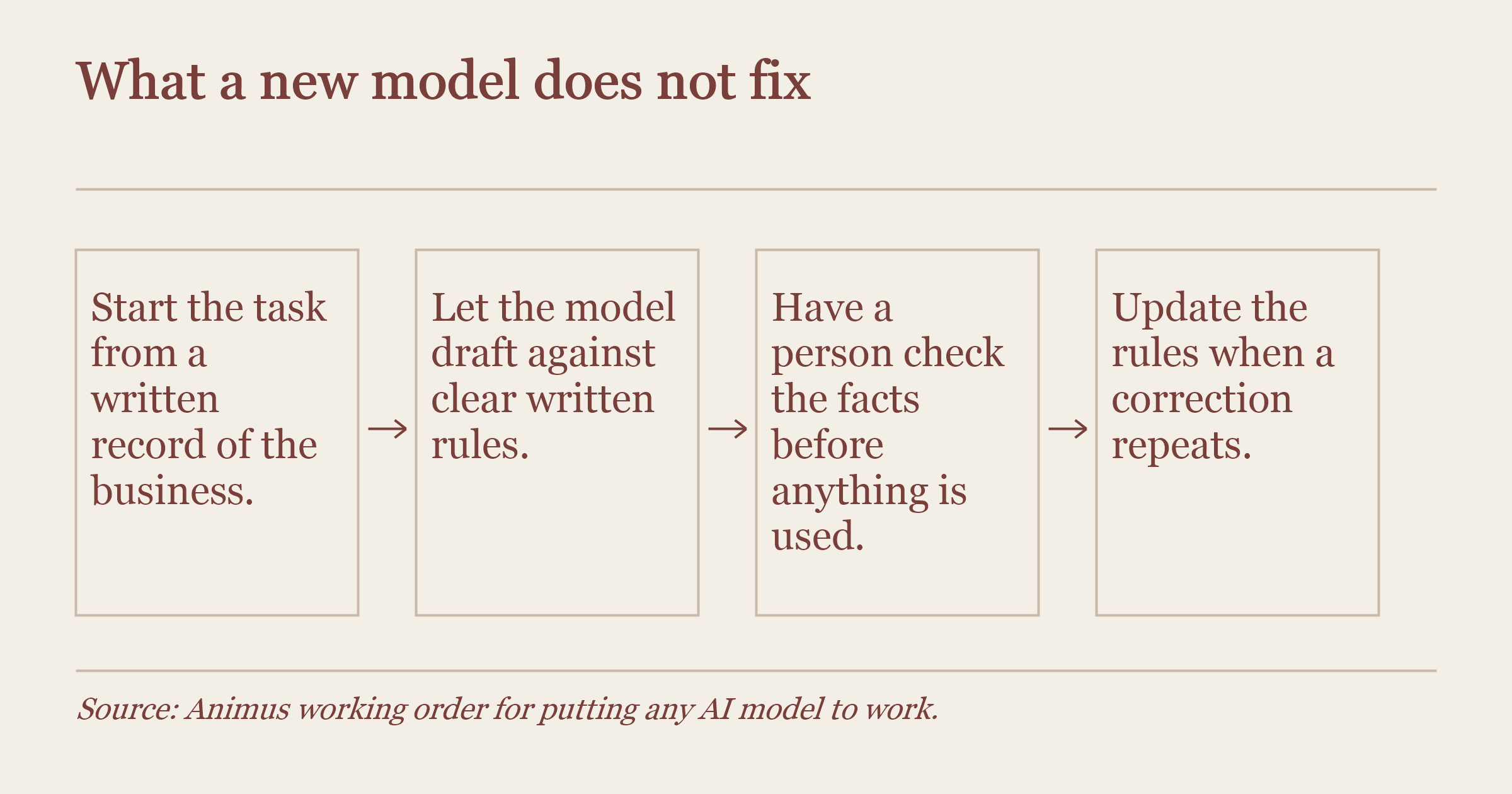
The last step is where a model upgrade pays off. If the same correction stops repeating after a switch to GPT-6 Sol, the new model earned its place. If it keeps repeating, the fix was always in the rules. We set out where AI fits in the rest of a marketing week in how to use AI in marketing.
Next step: run one task from last week on GPT-6 Sol and count the corrections, then book a strategy call and bring both versions.