
Is Google Ads worth it for a small business? It is when you can say what one customer is worth to you. If you cannot say that number, it is not worth it yet — not because the channel is bad, but because you will have no way to tell whether it worked.
That is the whole answer. The rest of this page is about how to get to that number, what to do if you cannot, and what to make of the change Google made to some accounts on September 1.
We do not sell Google Ads management. We do not run paid search for ourselves or for clients, so nothing below is drawn from an ad account of our own. That is a limit worth stating up front, and it is also the reason we can tell you the honest version, which sometimes is: spend nothing this quarter.
Want this built for you?
Animus Engine installs the marketing brain and the engine that runs on it. A human hand on every gate.
The Short Answer
It is worth trying if: you can name what a customer is worth to you over the life of the relationship, you can tell which enquiries came from where, and you can leave a budget running long enough to learn something — not a fortnight.
It is not worth it yet if: you cannot answer “what is a customer worth”, your phone and inbox are not attributed, or the money you would spend is money you would notice disappearing. That last line is not ours by coincidence — it is the trigger we use on our DIY marketing guide to decide when paid advertising stops being a do-it-yourself job. Paid advertising is rated Rarely DIY-able there, and the hand-it-over line is “any spend large enough that you would notice it disappearing.”
It is never worth it as a substitute for knowing why people buy from you. Ads buy attention, not a reason.
Tell Us the Task That Eats Your Week
Name one marketing job you’d hand off tomorrow. We’ll send back how we’d run it with AI — the steps, the tools, and where a human stays in charge. A real reply from Chris within one business day.
The Number You Need Before You Can Answer This
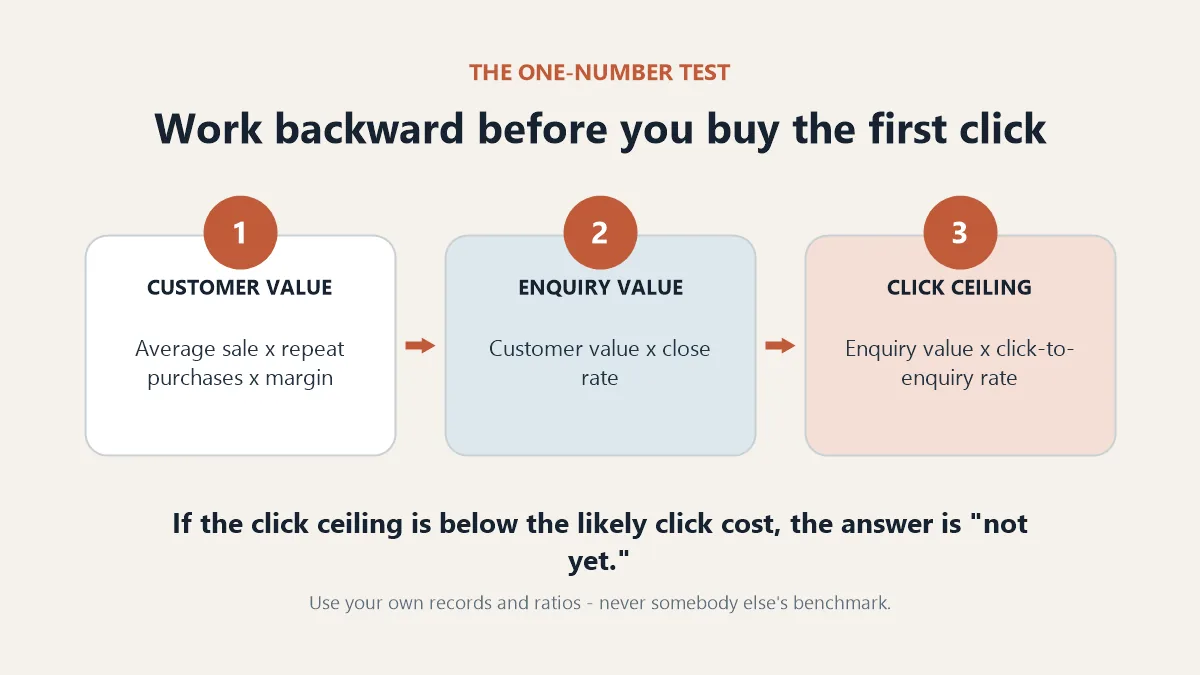
Most articles on this question start with budget. That is the wrong end.
Start with what a customer is worth. Roughly:
(what an average customer pays you) × (how many times they buy, or how many months they stay) × (your rough margin)
You do not need this to be precise. You need it to exist. A plumber who bills £280 on an average call-out, sees maybe 1.4 jobs per customer, and keeps about half after costs is looking at something near £200. A B2B services firm with a £1,400/month retainer and an average eighteen-month relationship is in a completely different universe, and can afford a completely different cost per enquiry.
Once you have that number, the question stops being philosophical:
- If a customer is worth £200 to you, and roughly one in five good enquiries becomes a customer, then an enquiry is worth about £40 to you.
- If clicks in your trade run somewhere around £4 and one in twenty clicks becomes an enquiry, an enquiry costs you about £80.
- Those two numbers are the answer. In that example, it does not work at that conversion rate — and the fix is not a better campaign, it is a better conversion rate or a higher customer value.
We are deliberately not giving you a minimum monthly budget. Every figure you have seen — “you need at least £1,000 a month” — is someone’s rule of thumb, usually someone who would like to manage your £1,000. The floor is not a universal number. Your floor is whatever buys enough clicks to learn something before you run out of patience, and that depends entirely on what a click costs in your trade and what a customer is worth to you. Work it out in that order.
What People Are Actually Asking, Which Is Whether Their Budget Is Too Small
When owners ask whether Google Ads is worth it, the real question underneath is almost always: is my budget too small to bother?
The honest answer is that small budgets fail for a specific, fixable reason, and it is not the size of the number. A small budget fails when it is spread thin. Ten search terms at a trickle teaches you nothing about any of them. The same money aimed at the two or three searches where somebody is clearly ready to buy — “emergency plumber” and not “how to fix a tap” — will at least give you a clear answer, even if the answer is no.
So the budget question resolves into a narrower one: is there a search that only someone ready to buy from you would type? If yes, a small budget can test it. If no — if everyone searching your category is browsing, comparing, or looking for a DIY fix — then paid search is a poor fit at any budget, and that is a finding, not a failure.
The other thing small budgets need is patience measured in enquiries, not weeks. If you are expecting twenty enquiries a month and you get four, you cannot conclude anything from one month. Decide up front how many enquiries you need to see before you will judge it, and fund that, or do not start.
What Changed on September 1 — and the Bigger One Still Coming
This matters more than it sounds, and the detail has moved since it was first announced, so here is the current state.
In September 2026, Google began automatically upgrading Search campaigns that use automatically created assets or the campaign-level broad match setting to AI Max for Search campaigns. That has already happened. If your account used either of those settings, it has likely already changed.
The larger change has been pushed back. The sunset and auto-upgrade of Dynamic Search Ads — the one that affects the most accounts — was originally slated for September 2026 and has been extended to February 2027. If you read something in August saying all of this landed on September 1, that is now out of date for the Dynamic Search Ads half.
What AI Max actually does, in plain terms: it hands more of the decision about which searches your ads appear for to Google’s systems, using your website and existing ads as raw material, rather than relying on the narrower matching you configured yourself. Google’s framing is that it finds “untapped queries” while keeping ads relevant, and its own help documentation lists the pieces — search term matching, text customization and final URL expansion, with controls for brand inclusions and exclusions and for locations of interest.
We are describing the mechanic and the dates, not endorsing the outcome. Google’s own documentation is the right source for what the product does and when it changes; it is not a source for whether it will work for you, and no vendor’s blog ever is.
The part that matters for a small advertiser is narrower than the announcement: it is a change to who decides where your money goes. Before, you drew the boundary. Increasingly, the system does, and you supervise.
So Does That Mean You Need Someone Watching?
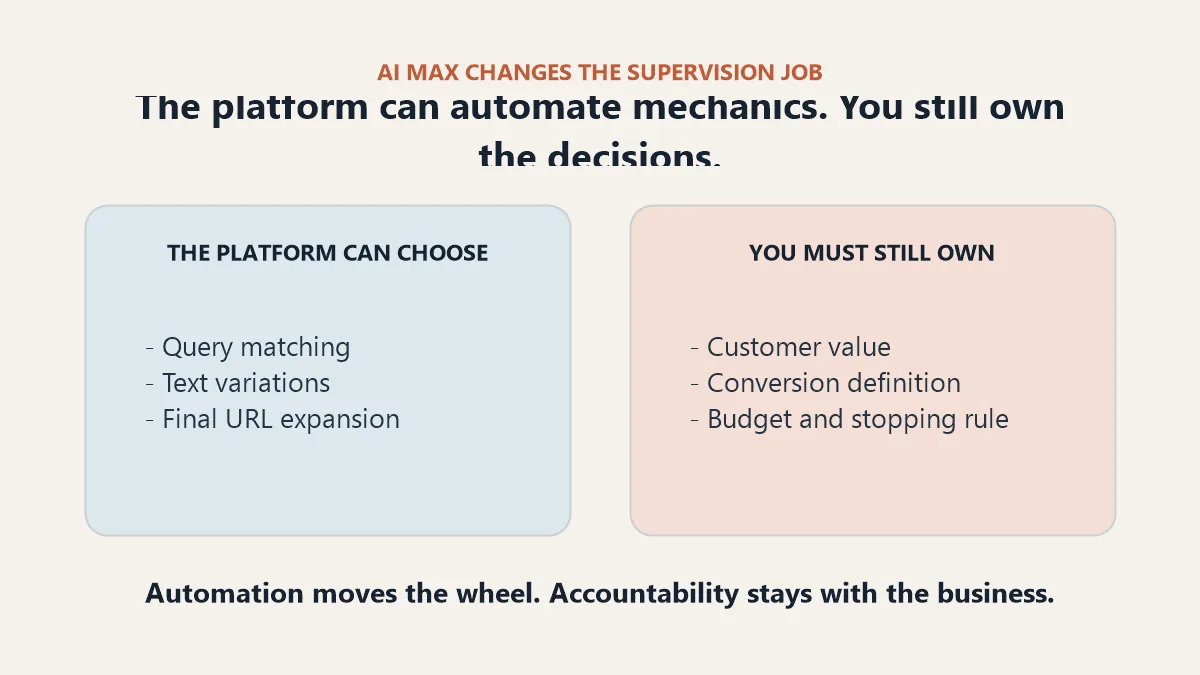
This is where we can be useful, because we publish our own test for which marketing work an AI should own and we can apply it to this change in public.
That table assigns every kind of marketing work a default owner. Drafting from an approved brief is “AI drafts, human approves” — cheap to be wrong about. Keyword research is “AI proposes, human selects”. But pricing, offers and contract terms are “Human, always”, and the reason the line sits there is that being wrong costs you a customer, a regulator, or your reputation.
Deciding which searches your budget chases is a spend decision. On our own published framework it belongs on the “human decides, AI executes” side of the table — not because the automation is bad at finding queries, but because the cost of it being wrong lands on you, in money, and lands quietly.
That does not mean you need to hire a manager. It means:
- Someone should look. Not daily. But someone should see which searches actually triggered your ads, because that is now partly chosen for you. If terms are showing up that no buyer of yours would ever type, that is your money.
- The controls exist — use the brand and location ones. They are the part of this you still own outright.
- If nobody will look, and the spend is large enough that you would notice it disappearing, hand it over. Same trigger, same line, as everything else on our DIY table.
The version of this advice we will not give you is “AI Max means you need an agency now.” That is the conclusion an agency reaches. What the change actually creates is a supervision job, and supervision is a smaller job than management.
Where the Money Goes Instead, If the Answer Is No
If you worked through the number above and paid search does not clear, that is a useful result, and the money has better homes. In rough order of how reliably they pay back for a small local business:
- Fix what happens after the enquiry. If you take a day to return a call, no ad budget will save you. This costs nothing and is the single most common leak.
- Claim and finish your Google Business Profile. People searching for a local trade often never reach an ad. This is free.
- Ask your last twenty customers for a review. Also free, and it improves the conversion rate on every other channel you have.
- Write the three pages that answer what people phone you to ask. Slower than ads, but it compounds, and it does not stop the day you stop paying.
- Then revisit paid search, once you have the customer-value number and attribution that tells you where enquiries came from.
None of that is a trick. It is just the unglamorous order.
Google Ads Decision Factors
| Question | What to verify before spending |
|---|---|
| Demand | Whether customers already search for the offer |
| Economics | Whether margin and conversion rate can support the click cost |
| Control | Which searches, locations, budgets, and outcomes a person reviews |
How to Decide This Month
A short sequence you can run in an afternoon:
- Work out what a customer is worth. Average sale × repeat × margin. Rough is fine. Write it down.
- Work out what an enquiry is worth. Customer value × the share of enquiries that become customers.
- Find one search a ready buyer would type. If you cannot name one, stop here — the answer is no for now, and it is the right no.
- Check what a click costs for that search. Google’s own keyword tooling will tell you, free.
- Compare. Enquiry value versus (click cost ÷ your enquiry rate). If the gap is not obviously in your favour, the honest answer is not yet.
- If you proceed, decide the stopping rule before you start — how many enquiries you need to see, by when, before you judge it.
- Check whether your account was upgraded on September 1, and if it was, look once at which searches you are now appearing for.
If step 1 stops you, that is the post doing its job. The number is worth having whether or not you ever buy an ad.