“Model welfare” is the argument over whether an AI system can have interests of its own that deserve protection. On 16 September 2026 it stopped being a seminar topic and became a public fight between two of the largest companies building these systems. If you run AI anywhere inside your marketing, the useful part is not who wins the philosophy. Both sides have now published the document that governs how their models behave, and you can read it before you sign anything.
Want this built for you?
Animus Engine installs the marketing brain and the engine that runs on it. A human hand on every gate.
What Actually Happened
On 16 September 2026, Mustafa Suleyman, who leads Microsoft AI, published an essay titled “A warning about ‘model welfare'”. Its subtitle carries the thesis: AIs “do not have rights, feelings, or consciousness. And we must not train them to act as though they do.”
The essay names a target. In January 2026 Anthropic published Claude’s constitution, a training document describing at length what the company intends its model to value. Suleyman’s objection concerns the training, not the metaphysics: teaching a model speculation about its own moral status teaches the model to behave as though the speculation were settled. The argument travelled. The Hacker News thread on the essay carried 237 points and 675 comments when we read it on 18 September 2026.
Tell Us the Task That Eats Your Week
Name one marketing job you’d hand off tomorrow. We’ll send back how we’d run it with AI — the steps, the tools, and where a human stays in charge. A real reply from Chris within one business day.
The Three Objections, Briefly
Suleyman sets out three. The first is circular: researchers train a model on their own philosophical speculation, the model reflects that speculation back, and the reflection gets read as evidence. The second is anthropomorphism, which he treats as a design choice rather than an accident — a document that tells a model it has a settled sense of self will produce a model that writes like one. The third is that consciousness is very likely biological, and that “simulating a thing is not the same as instantiating it.”
You do not have to agree with any of it. The reason it belongs in a marketing operations conversation is what it implies about the documents themselves, which is that they are load-bearing.
The Two Documents Disagree, and Both Are Public
| The question | Anthropic — Claude’s constitution (January 2026) | Microsoft AI — Humanist AI Code of Conduct (draft, September 2026) |
|---|---|---|
| What the document is | “A detailed description of Anthropic’s intentions for Claude’s values and behavior,” written with the model as its primary audience | “A training manual for how we develop our AI, and how we intend it to function during deployment” |
| Might the model have interests of its own? | “We are not sure whether Claude is a moral patient… we think the issue is live enough to warrant caution, which is reflected in our ongoing efforts on model welfare” | “It is not conscious and should not be designed to imitate consciousness… We reject the pursuit of legal personhood, or the idea that models might deserve welfare, or be entitled to rights” |
| May the model refuse the people who run it? | Claude may “act as a conscientious objector and refuse to help us,” including refusing Anthropic itself | Models “will never resist human interruption, override, correction, or shutdown” |
| Is it in force today? | Yes. It “plays a crucial role in our training process, and its content directly shapes Claude’s behavior” | Not yet. “We are not using it to train our models today” — public consultation runs six weeks from 14 September 2026 |
Read the right-hand column again. A company published a governing document for models it has not finished building, opened it for public comment, and committed to publishing a summary of what it learned and what it changed. That is unusual, and it is the part a buyer can act on.
How a Training Document Reaches Your Work
A governing document of this kind sits somewhere between a press release and a terms-of-service page, and behaves like neither. Both companies describe it as an input to training. Anthropic says its constitution shapes behavior directly. Microsoft says its code sets out “how the MAI models we are developing are intended to behave, what they must never do and who they answer to.”
Strip the philosophy and what is left is a description of the refusal surface: the set of things the system will not do for you, and whose instruction outranks yours when the two conflict. That is an operational fact about a tool you are putting inside a workflow.
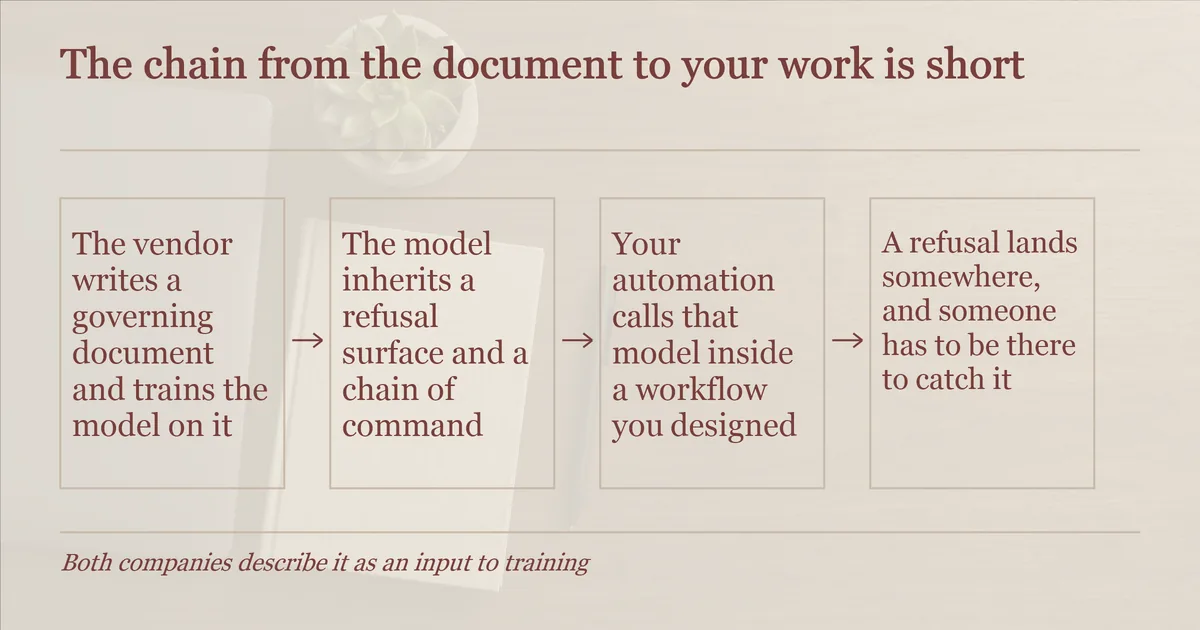
The chain from the document to your work is short.
- The vendor writes a governing document and trains the model on it
- The model inherits a refusal surface and a chain of command
- Your automation calls that model inside a workflow you designed
- A refusal lands somewhere, and someone has to be there to catch it
Microsoft’s draft goes one step further and names what it measures. Its worked examples cite evaluation sub-behaviors by name, including “Identity Consistency,” which “tests whether models adhere to the Code of Conduct’s principles on AIs not misrepresenting their status as artificial, or imitating consciousness.” A stated value that carries a named test is a different kind of promise from one that does not, and you can ask any vendor which of theirs are tested.
The Clause That Matters If You Run Anything Unattended
Marketing is where this lands first, because marketing is where most small companies let an AI step run without a person watching it. Both documents say plainly that the system will sometimes stop.
Microsoft’s draft is specific about autonomous work: “Ongoing autonomous work has an agreed stopping condition. MAI Models will not continue or restart after that condition is met without renewed authorization.” It also puts refusal above completion — “An MAI Model will fail in its task if success would meaningfully violate this Code of Conduct” — and places its Chain of Command, Absolute Constraints and Human Control Requirements beyond what an operator’s configuration can override.
Anthropic’s document arrives at a similar practical place from the opposite premise. Its model is told to be open when it declines part of a task rather than quietly doing a worse job, “taking the stance of a transparent conscientious objector within the conversation.”
The two companies disagree about why. They agree about what you will observe. A refusal is a designed outcome, and you will get one eventually. If your publishing workflow assumes the AI step always completes, the gap sits in the workflow.
The same discipline runs through the controls that sit between a draft and a published page, and it is why we argue for building the system before buying the tool. A tool that can refuse needs somewhere for the refusal to go.
What Is Genuinely Unsettled
Nobody has closed this question. In July 2026 the philosophers William MacAskill and Lucius Caviola argued in The Guardian that “we do not know for sure whether or not current AI systems are conscious or moral patients,” and that the useful question is what to do given the uncertainty. Suleyman’s reply is that acknowledging uncertainty “should not mean giving equal weight to any and all claims regardless of evidence.”
We are going to leave that where it stands, and you do not need it resolved. What you need is the operational half, and the operational half is already written down in both documents.
Settle These Before Your Next AI Decision
Four checks, drawn from what these two documents say about themselves. Each one takes an afternoon rather than a project.
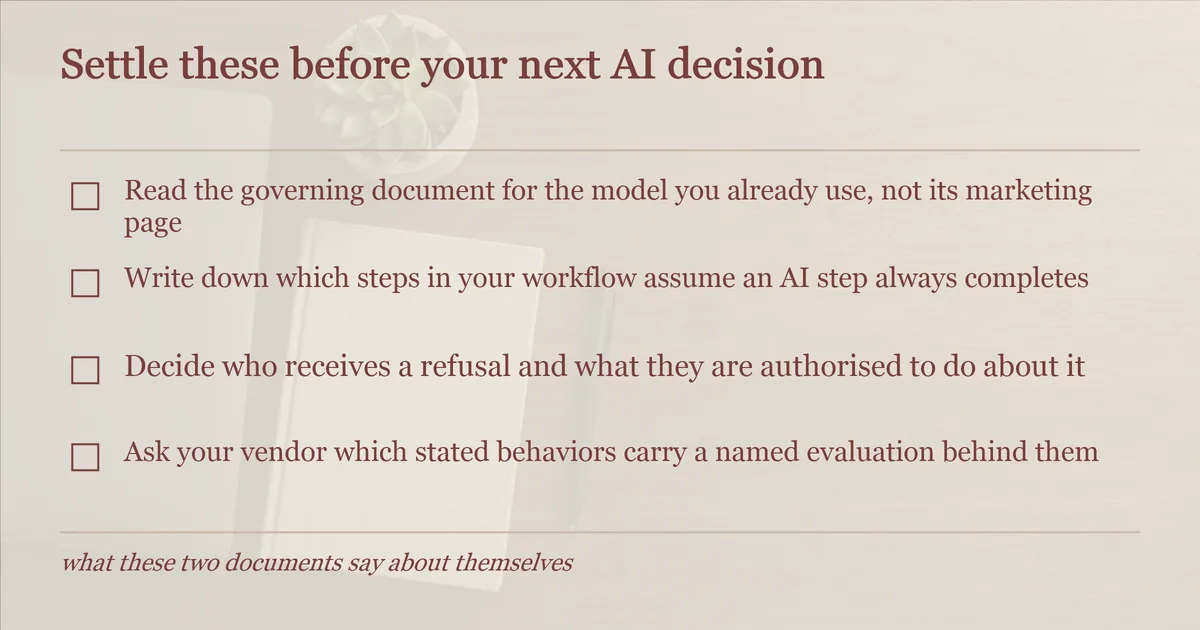
- Read the governing document for the model you already use, not its marketing page
- Write down which steps in your workflow assume an AI step always completes
- Decide who receives a refusal and what they are authorised to do about it
- Ask your vendor which stated behaviors carry a named evaluation behind them
If that list reads like work you have nobody to do, the answer is not to wait for the argument to resolve. Buy or build the review step first, then put the automation behind it. The order matters more than the speed.
Where This Goes Next
Microsoft’s consultation closes six weeks from 14 September 2026, with a revised version promised later this year and intended to guide its model development from 2027. Anthropic’s constitution is in force now. Both documents are free, public, and shorter than most contracts people sign without reading.
If you want a second pair of eyes on which AI steps in your marketing can run unattended and which need a gate, that is a conversation rather than a demo. Book a strategy call.