
The Short Answer: The Ad Became a Conversation You Have to Approve
A clicked ad inside ChatGPT can now open a separate, labelled conversation with an agent that a business sponsors. That is the change. The format is new, but the obligation underneath it is an old one that has quietly moved: somebody at your company has to decide, in advance, what a machine speaking in your name is allowed to say.
Want this built for you?
Animus Engine installs the marketing brain and the engine that runs on it. A human hand on every gate.
OpenAI published the announcement on 16 September 2026 under the title Reimagining advertising with AI. Its own one-line summary names three things: Sponsored Agents, tools for marketers, and integrations with HubSpot and Shopify. If you sell to consumers and you already buy search or social, this is the first ad format in years that asks you for something other than creative and a budget. It asks you for a governed answer.
Tell Us the Task That Eats Your Week
Name one marketing job you’d hand off tomorrow. We’ll send back how we’d run it with AI — the steps, the tools, and where a human stays in charge. A real reply from Chris within one business day.
What OpenAI Announced, and What It Did Not
OpenAI announced a test of Sponsored Agents alongside natural-language campaign tools and its first CRM and ecommerce partners. It did not, in the same post, publish how the new format is priced, how it is measured, or what a business gets to see from the conversations it pays for.
Every description of the format in this article traces to the OpenAI announcement, read from the OpenAI News feed, and to two independent trade reports read on the same day. That distinction matters more than usual here. A platform announcement is authoritative about what the platform officially offers and about very little else: it can tell you the format exists and how it is labelled, and it cannot tell you whether it works.
What OpenAI says about the format itself is specific. A Sponsored Agent conversation is clearly labelled, and it is kept distinct from ChatGPT’s independent answers and from the conversation the person was already having. A user chooses to open it, asks what they want, and can follow a link to the business when they are ready. Reporting from Search Engine Roundtable and PPC Land agrees on that shape, and both record it as a test with selected advertisers in the United States rather than something you can go and buy this afternoon.
The gaps are worth naming as gaps. PPC Land reports that the announcement covers neither pricing, nor what data an advertiser receives from a conversation, nor which model runs the agent, nor how the format is measured. We are not going to fill those in for you, and neither should anyone quoting a figure at you this month. You can read the source yourself: the OpenAI announcement is public.
What an AI Shopping Agent Does That a Banner Never Did
An AI shopping agent answers back: it takes a question your buyer invents on the spot and produces a reply in your name, at a moment when nobody from your company is watching. A banner never did that. A banner makes the same claim to everybody and the exchange ends at the click.
Think about what that does to the unit of work. For as long as there has been paid media, the creative unit has been a fixed asset: a headline, an image, a spot of fixed length. You approve it once and it says the same thing a million times. The unit here is not an asset at all. It is a policy about answers, and its quality is measured by the worst reply it will produce rather than by the best line you wrote.
That is not a reason to stay out. It is a reason to arrive with your answers already written. The businesses that will be comfortable with this format are the ones that already know what they will not claim, because they have written it down somewhere a colleague can read.
Agentic Commerce Is the Category. Your Campaign Is the Smaller Question.
Agentic commerce is the name for buying that happens inside an assistant instead of on your website. A sponsored agent is one product inside that shift, and the shift will outlast the product.
In the same week as this announcement, our own event feed logged two separate Google posts about agentic commerce and holiday shopping. Two of the largest advertising businesses in the world moved on the same idea within seven days of each other. Whatever happens to any single ad format, the direction of travel is a buyer who never sees your homepage and a machine that decides how you get described.
Which is why the paid question cannot be answered on its own. We wrote about the unpaid half of it after running the test on our own site, and the honest finding was that nobody outside those companies can show you the function that picks the names. The same caution applies to the paid side, one step earlier: you can control what you supply and what you approve, and you cannot control the summary.
Search Ad, Shopping Assistant, Sponsored Agent: Three Different Asks
Each of these formats asks you for a different thing, and the third one asks for something your marketing team may not currently produce. A search ad asks for a headline. An AI shopping assistant asks for a catalogue a machine can read. A sponsored agent asks for an approved answer to a question nobody has asked yet.
What Each Format Asks of You
| Format | What it asks you to supply | What it makes you responsible for |
|---|---|---|
| A search ad | One headline and one description, written once | Nothing you write after the click |
| An AI shopping assistant | A product catalogue a machine can read and trust | Accuracy in your feed, not persuasion in your copy |
| A sponsored agent | An approved answer to a question nobody has asked yet | A named human who owns what it says |
Read the right-hand column as a staffing question rather than as a media question. The first two rows describe work a marketing team already does. The third row is a decision that usually sits with whoever signs off on claims, and in a small business that is often the founder.
The Unanswered Question Is Who Approves What the Agent Says
The governance question arrives before the media question. An agent that speaks in your name needs an approval path, and that path has to exist inside your business whether or not the platform ever supplies one.
The path is short, and it is yours to build rather than to buy. Write the answer set before anything goes live: the claims you will stand behind, the ones you will not make, and the questions that must be handed to a person. Approve it by name, so that one human being owns the claim rather than a committee. Ship it into the platform as the agent’s working material rather than as a briefing document nobody opens. Read the log afterwards, because an answer nobody reviews is an answer nobody owns. That sequence is the approval path described in this article, and none of it depends on which platform you end up buying.
How an Approved Answer Reaches a Customer
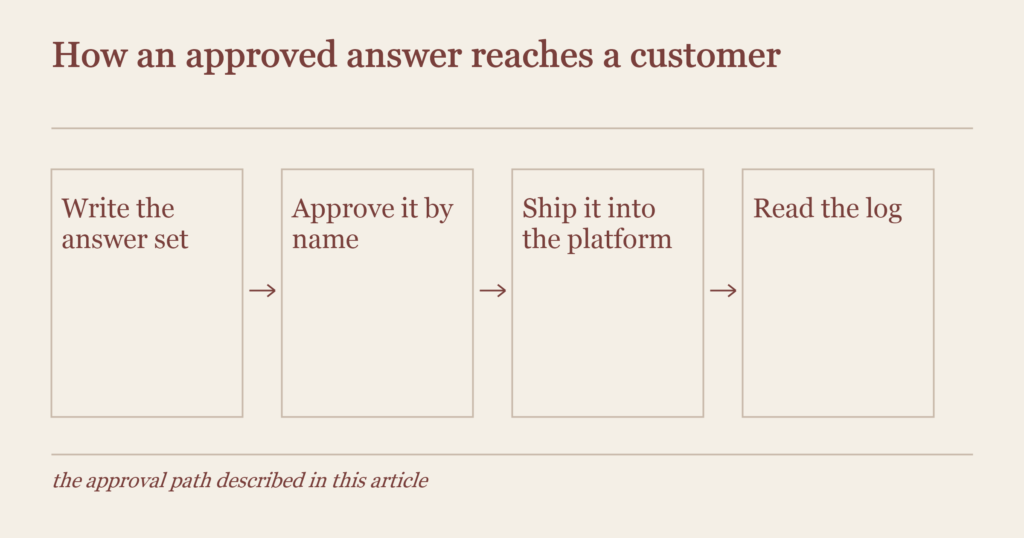
We run our own publishing that way, and we are open about what it costs. Verification before publish is not a slogan. It is a gate, and a gate is slower than no gate. The trade is that when something goes out under our name, a person approved it and the approval is written down.
What to Settle Before You Spend
Four decisions come before any budget, and every one of them is free. They are the four decisions named in this article, and you can finish all of them in an afternoon with the people who already work for you.
Who writes the answers comes first, because an agent is only as good as the material it is handed. Who approves them by name comes second, and a named person beats a process document. Where the log lives is third: a record you can open later, in a place you control, not a screenshot in somebody’s inbox. What the agent must refuse is fourth and gets skipped most often. Write the refusals down. Pricing you have not set, availability you cannot promise, comparisons with named competitors, and anything a regulator would read as a testimonial.
Settle These Before You Spend
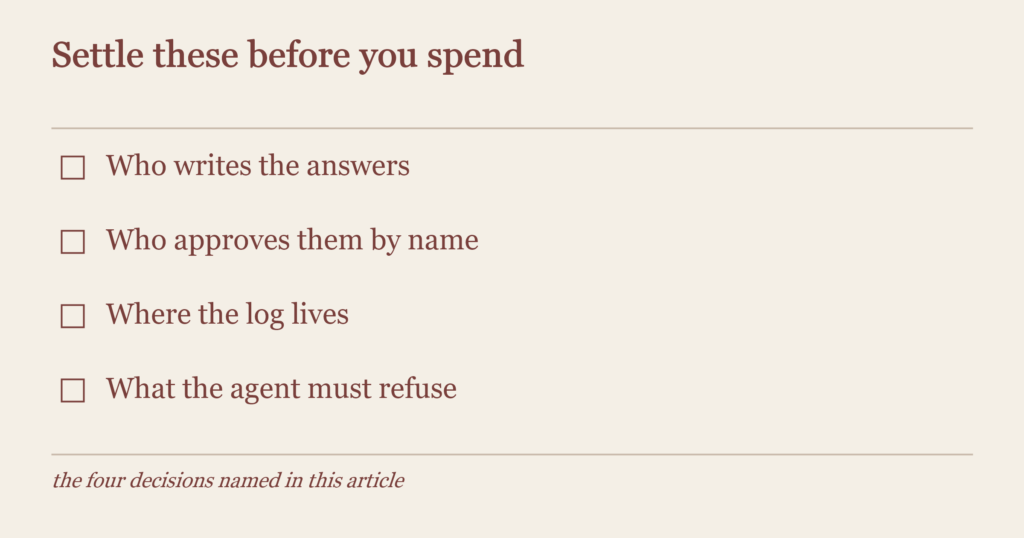
If you cannot answer all four today, that is the specification for the thing to buy or build first. A written answer set and a named approver cost less than a media test, and they are useful the moment you have them, on every channel you already run.
The Unpaid Half of the Same Problem
Paid placement inside an assistant does not replace being named by one without paying, and the unpaid half is the cheaper half to fix. It runs on machinery you already own: whether your pages state, in a vocabulary software understands, what you sell and where you work. We ran that check on our own site and published what it returned, including the two of the six rows we said we would fail on our own check, as of 16 August 2026.
Do that work first. It costs attention rather than budget, you can verify it yourself, and it makes any paid experiment legible if you decide to run one. If you are earlier than that and still deciding where AI belongs in the work at all, our guide to using AI in marketing is the better starting point.
What to Do This Week
Write the four answers down on one page, with the name of the person who approves each one beside it. This is not a strategy document and it should not take longer than an afternoon. Then read the OpenAI announcement yourself rather than a summary of it, this one included, and notice how much of it is a test rather than a product. When the format opens up, the businesses ready to use it will be the ones that wrote their refusals before a platform asked for them.
If you would rather work through it against your own business, book a strategy call. Thirty minutes, and we will write the first version of your answer set while you watch. Founder-operated. Limited client intake.