AI Max Transfers Three Shopping Campaign Controls to Google
Google Ads AI Max for Shopping is an upgrade path for retailers already running Shopping campaigns, and Google is pushing it now because the holiday season is the moment retailers are most willing to change something. The pitch is that it captures demand your exact-match product targeting misses. The claim is plausible, but the cost is control. Google chooses who writes the headline, which page receives the click and which ad format appears. Your team used to make each choice separately. After the upgrade, Google makes them together.
Want this built for you?
Animus Engine installs the marketing brain and the engine that runs on it. A human hand on every gate.
None of that is hidden. Google states it plainly in its own launch post. But a control you gave away deliberately behaves very differently from one you gave away in a one-click flow during your busiest month, and nothing in the announcement asks you which of those you are doing.
Tell Us the Task That Eats Your Week
Name one marketing job you’d hand off tomorrow. We’ll send back how we’d run it with AI — the steps, the tools, and where a human stays in charge. A real reply from Chris within one business day.
What Google Actually Published, and When
Two posts, four and a half months apart, and they do not quite agree.
On 30 April 2026, Google published Upgrade your Shopping campaigns with AI Max, describing the product as launching and naming three features. On 16 September 2026, the Ads & Commerce blog published an Ads Decoded podcast episode in which Ads Product Liaison Ginny Marvin interviews Enric Durany, Group Product Manager for retail ad experiences, recorded after Google’s Rethink Retail event in New York City. That post describes AI Max for Shopping as being in open beta, and names only two of the three features.
The September post’s key takeaways are short enough to read in full. The first is “Balancing bottom-funnel performance with upper-funnel discovery.” The second tells you to leverage the new AI Max for Shopping, now in open beta, including text customization and Final URL expansion, to automatically capture evolving search intent. The third bullet, as published, is garbled mid-sentence and does not parse; we are not going to guess at what it was meant to say.
So: launched in April, open beta in September, one feature quietly absent from the later description. That mismatch fits a staged rollout. Anyone describing AI Max for Shopping as generally available and fully specified is ahead of the published record.
The Three Controls, in Google’s Own Words
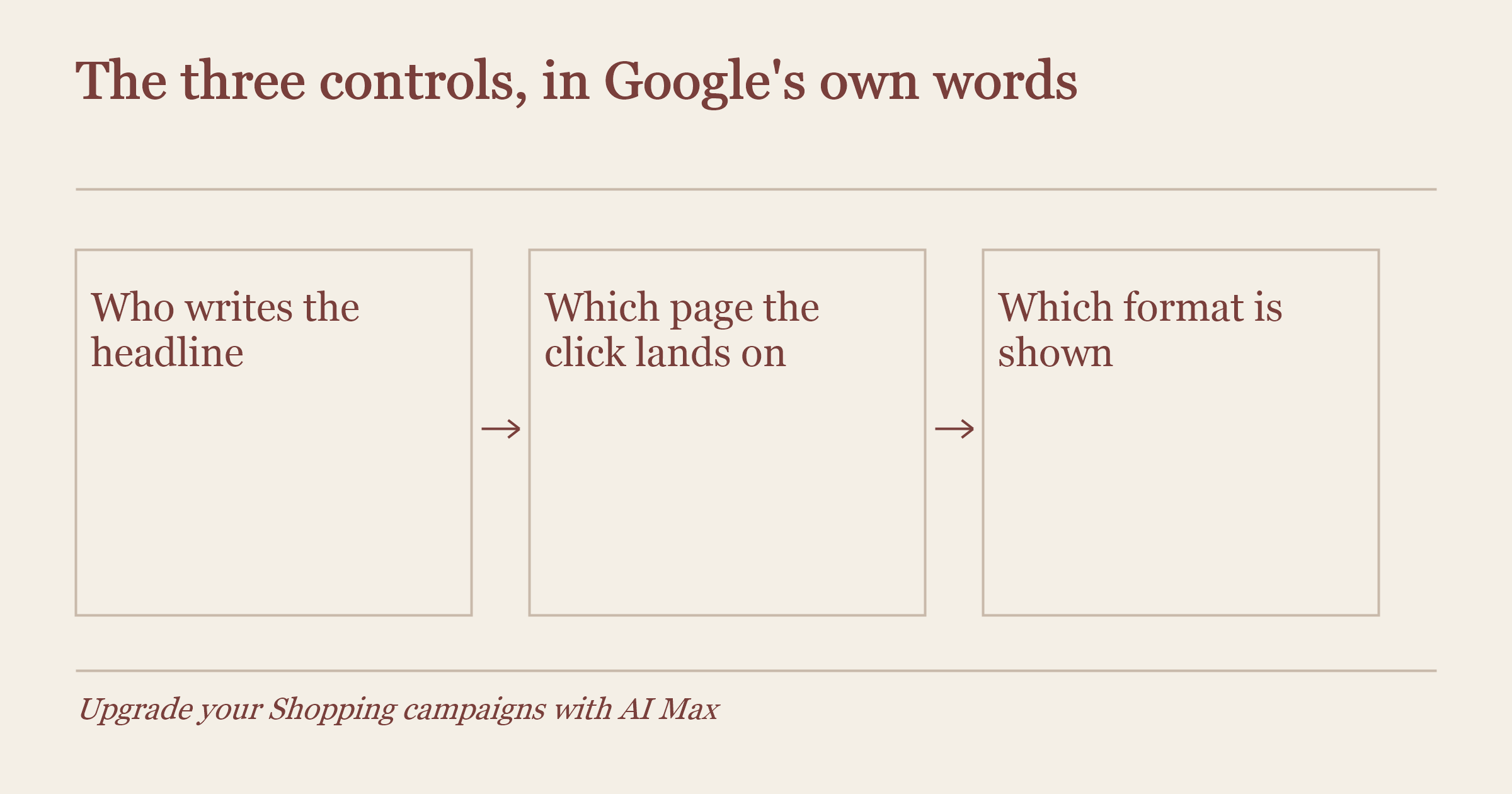
The April launch post assigns each feature a specific job:
What Each Feature Decides for You
| Feature | What Google says it does | The decision that moves |
|---|---|---|
| Text customization | “Generates ad copy for your Shopping ads so that they speak directly to shopper intent and conversational queries.” | Who writes the headline |
| Final URL Expansion | “Matches your site’s most relevant landing pages to a shopper’s intent.” | Which page the click lands on |
| Optimal Format Selection | Automatically selects the best format, text or Shopping ads, based on what is most relevant to the shopper’s needs. | Which format is shown |
Google is also explicit about what you keep: “You retain your existing product targeting controls and bidding flexibility, with the option to turn off FUE at any time to restrict ad delivery to Shopping ads.” That escape hatch is real and it is worth knowing about before you need it. It is also the only one of the three that Google names as switchable off.
Final URL Expansion Depends on Landing-Page Readiness
Final URL Expansion reaches beyond campaign settings. Google may send paid traffic to any page on your site it judges relevant, including pages you have never considered as a landing page.
Every retailer has those pages. The discontinued line you left up for SEO. The size guide. The blog post from two years ago that still ranks. A stale category page with four products in it. An out-of-stock bestseller. None of those were written to convert a stranger who just clicked a paid ad, and some of them will actively lose the sale.
So the prerequisite is not an advertising task. It is an inventory of your own site, asking one question of every page a machine might pick: if a stranger landed here from a paid click, would this page let them buy? If the answer is no, the page needs fixing, excluding, or taking down, and that work is slower than the upgrade that creates the need for it. Do it first. The same instinct applies to the unpaid side of your site, which we wrote about after running the same test on our own site and reporting the two of the six rows we said we would fail on our own check, as of 16 August 2026.
The Timing Question the Announcement Does Not Raise
A podcast about driving holiday sales, recommending you change campaign type during the run-up to the holidays, is worth reading twice.
The argument for moving now is straightforward: the traffic is here, so capture it. The argument against is that peak season is the single worst window in which to lose your ability to interpret a result. Automated systems need a learning period, your competitors are bidding differently than they do in March, and your own demand curve is abnormal. Change the campaign type in that window and you get one number at the end of it: revenue. You cannot separate the upgrade from seasonal demand and competitor bidding, and your own discounting adds another variable.
That does not settle it. A retailer whose whole year is the fourth quarter may rationally decide that a season you cannot cleanly measure still beats a season you sat out. The point is that it is a decision with a cost, and the announcement presents it as a free upgrade. Make it consciously, and write down which way you went and why, so that next year’s version of you can read it.
What Neither Post Contains
We checked both article bodies mechanically. Neither reports a conversion-lift figure or a test window. Neither names its advertiser sample or a retailer result.
We are flagging the absence rather than treating it as damning. Vendor performance figures are usually worth very little anyway. They often omit the method and test window, and they tend to describe only the advertisers who stayed. But it does mean nobody can currently tell you what AI Max for Shopping is worth, including Google, and anyone quoting you a percentage this quarter got it from somewhere other than the published record. Ask them where.
Which leaves you where vendor announcements usually leave you: the only number that will mean anything about your account is one you generate yourself. If you are not sure the channel earns its place at all before you add automation to it, that is the prior question, and we have written it up for a small business deciding on Google Ads.
What to Settle Before You Click Upgrade
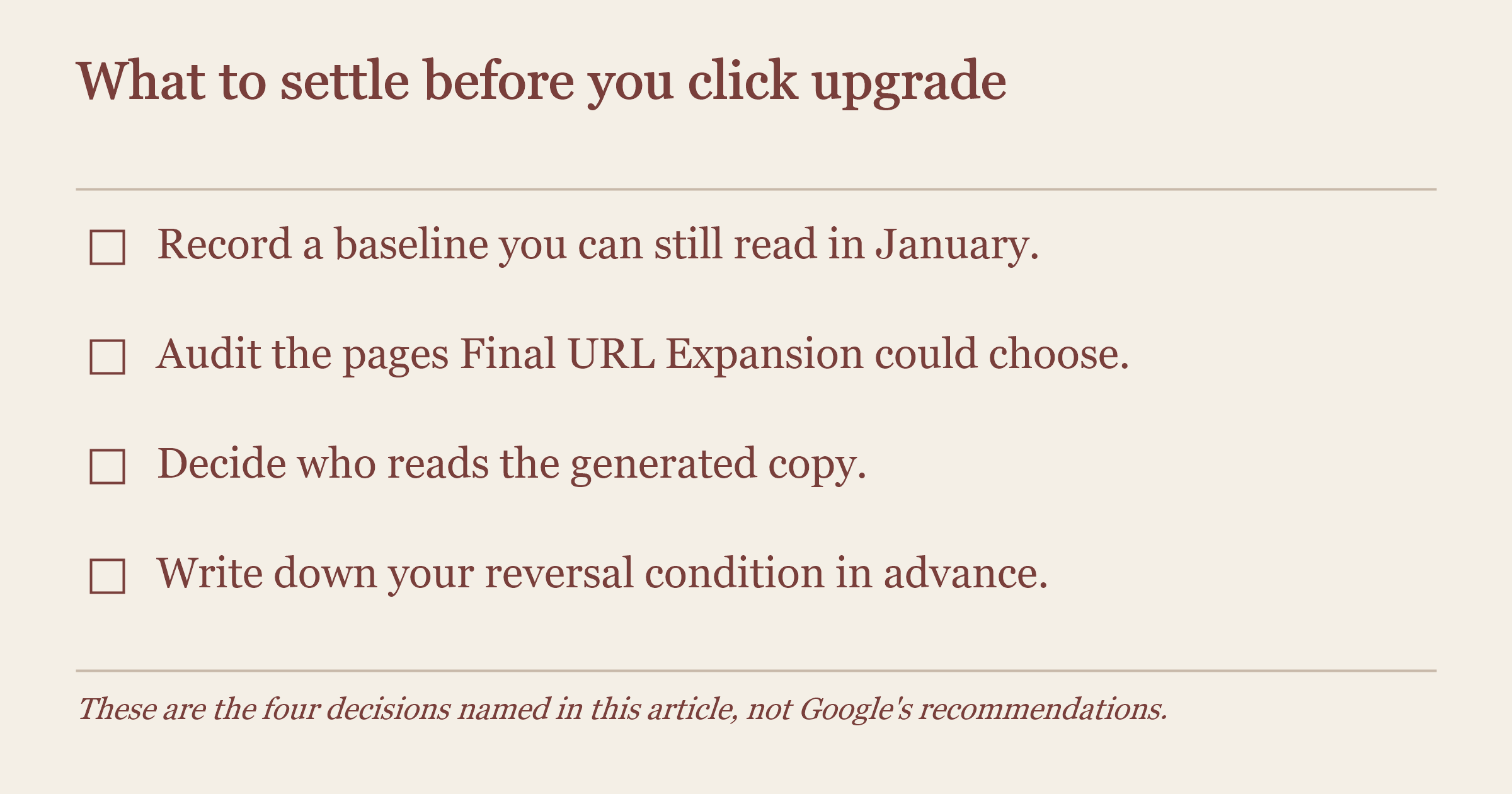
I would settle four decisions before changing the campaign. Each becomes harder to make after the upgrade, and none requires additional ad spend. These decisions come from this analysis, not Google’s recommendations.
Settle These First
- Record a baseline you can still read in January. Export current performance by campaign before you change anything. After the upgrade, the comparison you want no longer exists.
- Audit the pages Final URL Expansion could choose. Walk your own site as a stranger arriving on a paid click. Fix, exclude or remove anything that would not let them buy.
- Decide who reads the generated copy. Text customization writes headlines in your name. Name the person who reviews what it produced, and when.
- Write down your reversal condition in advance. What result, by what date, makes you turn Final URL Expansion back off? Decide it now, while you are calm and the season has not started.
A written reversal condition prevents an in-season result from becoming an improvised call. Set the threshold and date before the campaign changes.
What to Do This Week
- Export your current Shopping campaign performance and save it somewhere that is not the ads interface.
- List every page on your site a machine might reasonably call relevant to a product query. Read four of them as a stranger would.
- Decide whether this season or the quiet one after it is the season to change campaign type. Write the reason down either way.
- If you upgrade, set a calendar reminder to read the generated ad copy in seven days. Not to approve it in advance, because you cannot, but to catch what it actually said.
- Note that Google says Performance Max “remains your go-to” for cross-channel work. AI Max for Shopping is not a replacement for it, and treating it as one is the most likely way to get this wrong.
AI Max for Shopping makes a defensible trade: retailers give Google more control over ads in exchange for broader matching. Google introduced it just before the holiday season, when clean evaluation is harder. If you are still working out where automation belongs across the rest of the function, start with the system rather than the tool and come back to this when the season is over.