
One vendor guide says interactive advertising lifts brand recall by more than half, and its link for that claim leads to a review of 32 studies that found the evidence mixed. That does not make quizzes, polls and shoppable ads a bad idea for a small business. It means the honest advantages are different from the advertised ones, and the only number you can trust is the one from your own test.
Interactive ads ask the viewer to do something: answer a poll, take a short quiz, tap a product to see the price, or try a product on through the phone camera. A standard ad asks them only to look. The difference is real, and it is worth paying for in the right place. This guide separates what holds up from what is repeated, then shows you how to test one interactive format against the ad you already run.
Want this built for you?
Animus Engine installs the marketing brain and the engine that runs on it. A human hand on every gate.
What Interactive Advertising Means for a Small Business
Interactive advertising is any ad that changes when the viewer acts on it, and for a small business the practical formats are polls, quizzes, shoppable product tags and simple try-on or preview tools. The larger formats, such as playable mini-games, 360-degree video and augmented reality showrooms, exist too, but they usually need a developer, which is hard to justify for one local campaign.
The vendor guides list the same family of formats. Nexd’s guide names playable ads, augmented reality ads, 360-degree video, shoppable ads and gamified ads such as quizzes and scratch cards. Agility PR Solutions points to the poll, slider and question stickers that Instagram offers in Stories and Reels. Those built-in stickers matter most to you, because they sit inside content you already make rather than in a separate ad you have to build.
Tell Us the Task That Eats Your Week
Name one marketing job you’d hand off tomorrow. We’ll send back how we’d run it with AI — the steps, the tools, and where a human stays in charge. A real reply from Chris within one business day.
The Advantages That Hold Up Without a Statistic
Three advantages of interactive advertising hold up on their own logic: the viewer tells you something, the viewer chooses to take part, and the format gives you a second thing to measure besides the click.
- The answer is information you did not have. A poll that asks which of two products a viewer would choose, or a quiz that ends in a recommendation, returns a choice made by a real prospect. The Media Ant describes this as deeper customer insight; in plain terms, it is a small survey attached to an ad you were running anyway. A standard ad cannot tell you which offer people preferred. It can only tell you who clicked.
- Taking part is a stronger signal than looking. Someone who answers three quiz questions about their kitchen has told you more about their intent than someone who scrolled past a photo of a kitchen. That does not guarantee a sale. It does give you a better-sorted list of who to follow up with.
- You get an extra measurement. Each interaction can be counted: how many people started the quiz, how many finished it, which answer won. Those counts are simple to read, which matters for a business that does not have an analyst.
None of those three needs a recall percentage to be true. They follow from what the format does, and you can check each one in your own account.
The Numbers Behind the Common Claims
Across three interactive advertising articles, we counted 15 statements that give a figure, and only 2 of them link to the source the figure came from. We read every statement in the three source articles listed at the end of this guide and counted each sentence that states a performance or audience number. We excluded a vendor’s claims about its own product.
Figure Statements in Three Interactive Advertising Articles
| Article | Statements giving a figure | Statements linked to the figure’s source |
|---|---|---|
| Agility PR Solutions, Bulldog Reporter | 10 | 0 |
| Nexd blog | 5 | 2 |
| The Media Ant | 0 | 0 |
| Total | 15 | 2 |
This is a count of three articles, not a survey of the industry. It says nothing about whether any single figure is right. What it shows is narrower and more useful: when you read “47% more time spent” or “a 91% completion rate,” you usually cannot check where the number came from. The Agility article names four sources in its own text without linking any of them. Of the two Nexd figures that do carry a link, one leads to a paywalled case-study page we could not open, and the other leads to the research review below.
What the Research Review Actually Found
The research linked behind the “over 50% brand recall” claim is a scoping review in PLOS ONE, and it reported mixed evidence on whether interactivity improves recall at all. The authors, from RTI International and the United States Food and Drug Administration, screened research published from 1997 through February 2021 and included 32 studies.
Their findings cut both ways. In one study, viewers spent more time with a high-interactivity TV ad, 6.1 minutes against 4.4 minutes for the low-interactivity version. In another, interactive ads were viewed for less time than non-interactive ones. A meta-analysis they included found no significant link between interactivity and measures such as recall and comprehension, with a correlation of 0.05. One study found that people who viewed a simple, linear web page scored highest when asked to recall the product information.
The real-world comparison is the most useful line for an advertiser. In a smoking-cessation campaign, 9.1% of people who clicked an interactive online ad registered for treatment, against 18.6% of people who arrived from traditional media. The review’s own conclusion, read in the full paper, is that there is no conclusive evidence on how interactive ads compare with non-interactive ads for engagement, recall or comprehension.
That is not a case against interactive ads. It is a case against buying them on a borrowed percentage. A click on an interactive ad is a different event from a customer, and in the review’s real-world example the interactive route registered people at less than half the rate.
What Interactive Ads Cost You Beyond the Media Spend
The cost of an interactive ad for a small business is mostly time and care, not media spend: someone has to build it, check it on a phone, handle the data it collects, and refresh it before the audience tires of it. The Media Ant lists these challenges itself: higher development costs, technical complexity, privacy concerns, device compatibility, creative fatigue and measurement complexity.
For a small business, privacy deserves the most attention. A quiz that asks for an email address or a ZIP code is collecting personal data, and the promises in your privacy policy apply to it. Keep the questions to what you will actually use. A poll about which product a viewer prefers needs no personal details at all.
Five Questions Before You Build an Interactive Ad
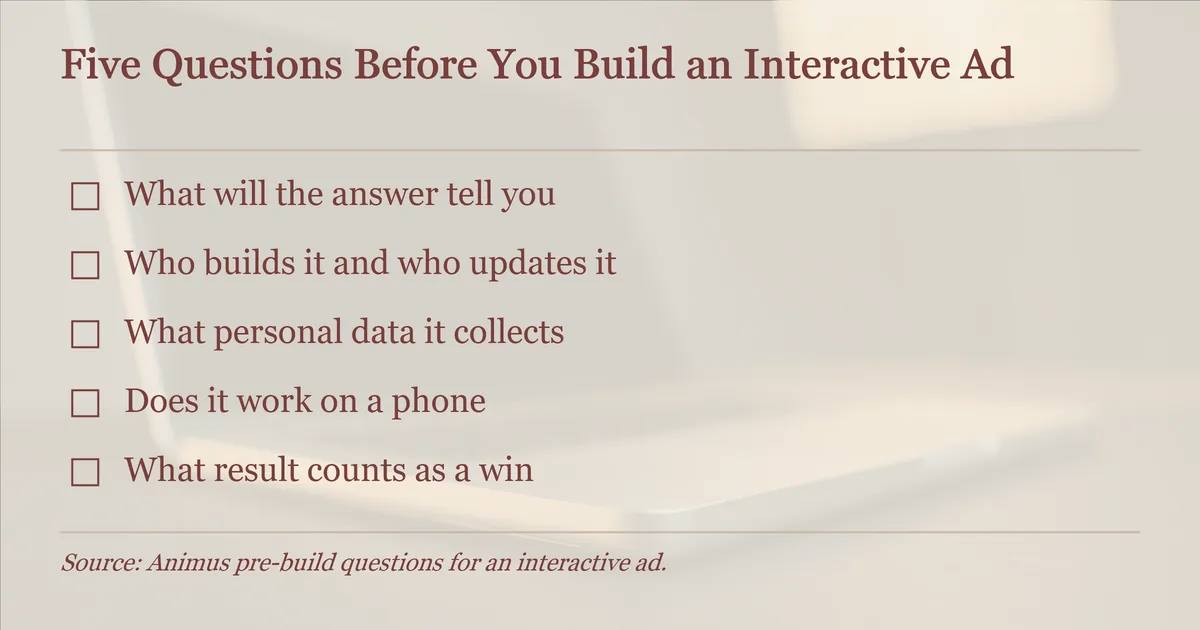
- What will the answer tell you
- Who builds it and who updates it
- What personal data it collects
- Does it work on a phone
- What result counts as a win
If you cannot answer the first question, the interactive part is decoration. Keep the standard ad, which is cheaper to make and easier to read, until you know what you want to learn from the viewer.
How to Test One Interactive Format Against Your Standard Ad
The reliable way to learn the advantage of interactive advertising for your business is one controlled test: the same offer, the same audience and the same budget, with only the format changed. Run the two versions as separate ads with the same audience and budget; the Nexd guide itself recommends A/B testing as the way to refine interactive ads.
One Interactive Test, Start to Finish
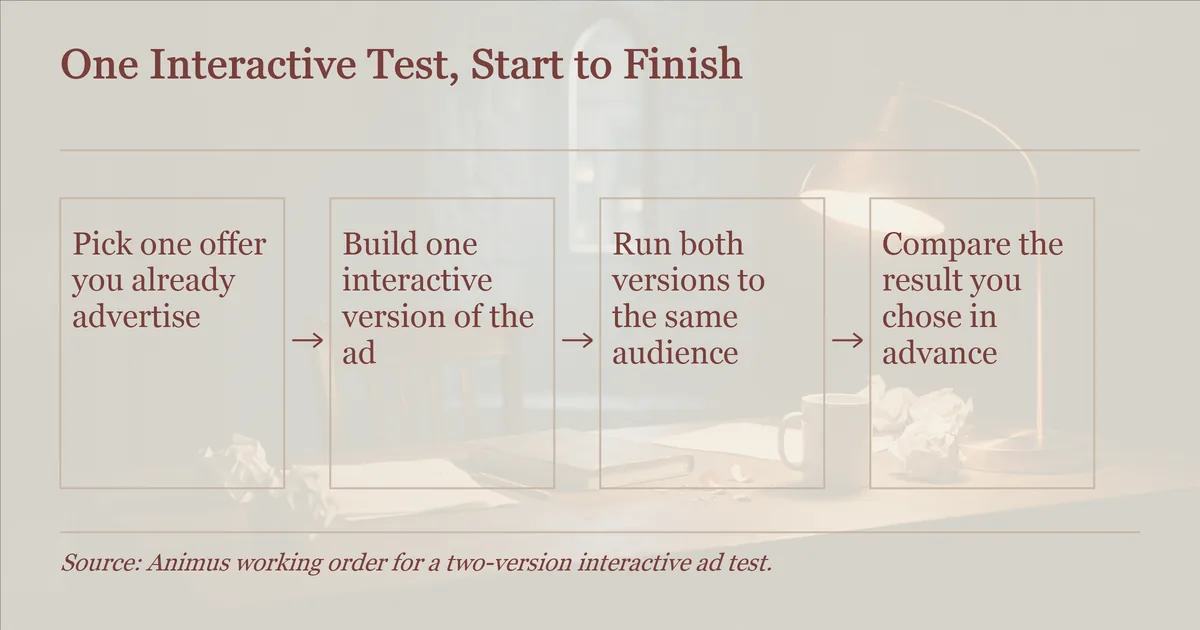
- Pick one offer you already advertise
- Build one interactive version of the ad
- Run both versions to the same audience
- Compare the result you chose in advance
Choose the result before the test starts, and choose one that pays the bills: a booking, an inquiry or a sale. Engagement counts will tend to favor the interactive version, because tapping a poll is an engagement. If you judge the test on engagement, the interactive ad wins by definition and you have learned nothing.
Run the test long enough for each version to collect enough results that one good day cannot decide it. Then keep the winner and write down what you learned from the answers people gave, because that information is yours whichever version won. If you are already testing ad copy, our guide to AI ad variations covers how to keep one change per test, and our marketing operations measures show how to pick a result that changes a decision.
Want a second pair of eyes on your first test? Bring the offer you advertise and the result that matters to you, and we will work through how to set up a fair two-version test with you. Book a strategy call.
Sources
- Giombi K. et al., “The impact of interactive advertising on consumer engagement, recall, and understanding: A scoping systematic review for informing regulatory science,” PLOS ONE, published 3 February 2022; accessed 5 October 2026.
- Nexd, “The Role of Interactive Ads in Increasing User Engagement”, published 26 July 2024; accessed 5 October 2026.
- Agility PR Solutions, Bulldog Reporter, “The rise of interactive ads: Why Gen Z prefers them, top platforms, and how to create them”, published 20 February 2025; accessed 5 October 2026.
- The Media Ant, “Top 10 Benefits of Interactive Advertising in the Digital Age”, published 29 January 2024; accessed 5 October 2026.