
One prompt can now ask an AI tool for 100 versions of your best ad. That is the example OpenAI chose on 21 September 2026 to describe how Higgsfield AI uses its GPT-6 Astra model, and it is an example of a request, not a result. The published story reports no performance figure for any ad those variations produced.
That gap is the useful part for a small business. The capability is real enough for OpenAI to publish it with Higgsfield’s chief executive on the record. Whether a batch of variations of your ad sells more of your product is a question the announcement does not try to answer, and it is the question you are paying to have answered.
Want this built for you?
Animus Engine installs the marketing brain and the engine that runs on it. A human hand on every gate.
What OpenAI and Higgsfield Actually Said
OpenAI’s customer story on Higgsfield AI makes three claims, and all three are the companies describing their own work. That makes them good evidence of what the product is built to do and weak evidence of what it does for a buyer. We report them as the claimant’s statements and do not restate them as our findings.
The Three Claims in the Higgsfield Story, and Who Makes Them
| Claim | Who says it | What it is evidence of |
|---|---|---|
| A request such as “Take my top-performing ad and generate 100 new variations” becomes new creative directions, including versions for different countries | OpenAI, describing the Higgsfield workflow | What the workflow is designed to accept |
| One engineer can now deliver new features within a day | Alex Mashrabov, co-founder and chief executive of Higgsfield AI | How fast Higgsfield ships its own software |
| Smaller businesses can sell more products by generating ads with video AI | Alex Mashrabov | The company’s own expectation, stated without a figure |
Read the second row carefully. “Within a day” describes Higgsfield’s engineers shipping features into their own product. It says nothing about how long your ads take to make, or how they perform once they run.
Tell Us the Task That Eats Your Week
Name one marketing job you’d hand off tomorrow. We’ll send back how we’d run it with AI — the steps, the tools, and where a human stays in charge. A real reply from Chris within one business day.
What the Higgsfield Story Does Not Show
The story publishes no performance numbers at all. It names no small-business customer and describes no test comparing an original ad with its variations. Customer stories are usually written this way, and Higgsfield is not unusual here. It does mean the only statement about small-business results in the piece is an expectation, attributed to the chief executive of the company selling the tool.
What the story does establish is narrower and still worth knowing. A tool built on a frontier model now accepts a plain-language request to rework an existing ad for different audiences and markets. For a business without a designer, the hard part of making variations has moved from production to judgement.
Each Variation Is Still an Ad You Are Responsible For
The Federal Trade Commission’s standard applies to every version of an ad you run, however it was made. The FTC’s advertising guide for small business puts it plainly: advertising must be truthful and non-deceptive, and advertisers must have evidence to back up their claims.
That standard gets harder to meet as the batch grows. A person adapting an ad for a new market tends to carry the original claim across unchanged. A model asked for new creative directions is being asked to change things, and a changed headline can quietly become a new claim, such as a faster delivery time or a feature the product does not have. The same guide notes that the FTC also looks at what an ad does not say, when leaving something out gives people the wrong impression. A shortened variation can drop the qualifier the original carried.
Four Checks Before You Run AI-Made Variations
Four checks, done before a variation spends any money, keep a batch of AI-made ads inside what you can prove. None of them needs special software, and together they are the part of the process that stays yours.
- Every claim in the variation is one you can back with evidence today.
- The product in the ad is the product you sell, in the version you sell.
- Each country or audience version is correct for that market, including the language and anything you promise there.
- You know what each variation is testing, so a result tells you something.

The fourth check is the one volume makes hardest. When a batch of variations runs at once, the same budget is split across all of them, and each one gets less spend to prove itself. A small budget spread across a large batch can return a pile of inconclusive results instead of one clear answer. Fewer variations, each changing one thing, usually teach you more. The same one-change test works when you compare an interactive ad with a standard ad.
Where a Person Still Sits in the Loop
A person still decides which variations may run and which result counts. The tool in the Higgsfield story generates options. It does not know which of your claims you can prove, and it cannot see your sales. This is the order we would run it in.
- Start from an ad that has already sold something.
- Ask the tool for a small batch of variations, each changing one thing.
- Check every variation against the four checks above before it runs.
- Run the batch and keep the version that sold, not the one that looked best.
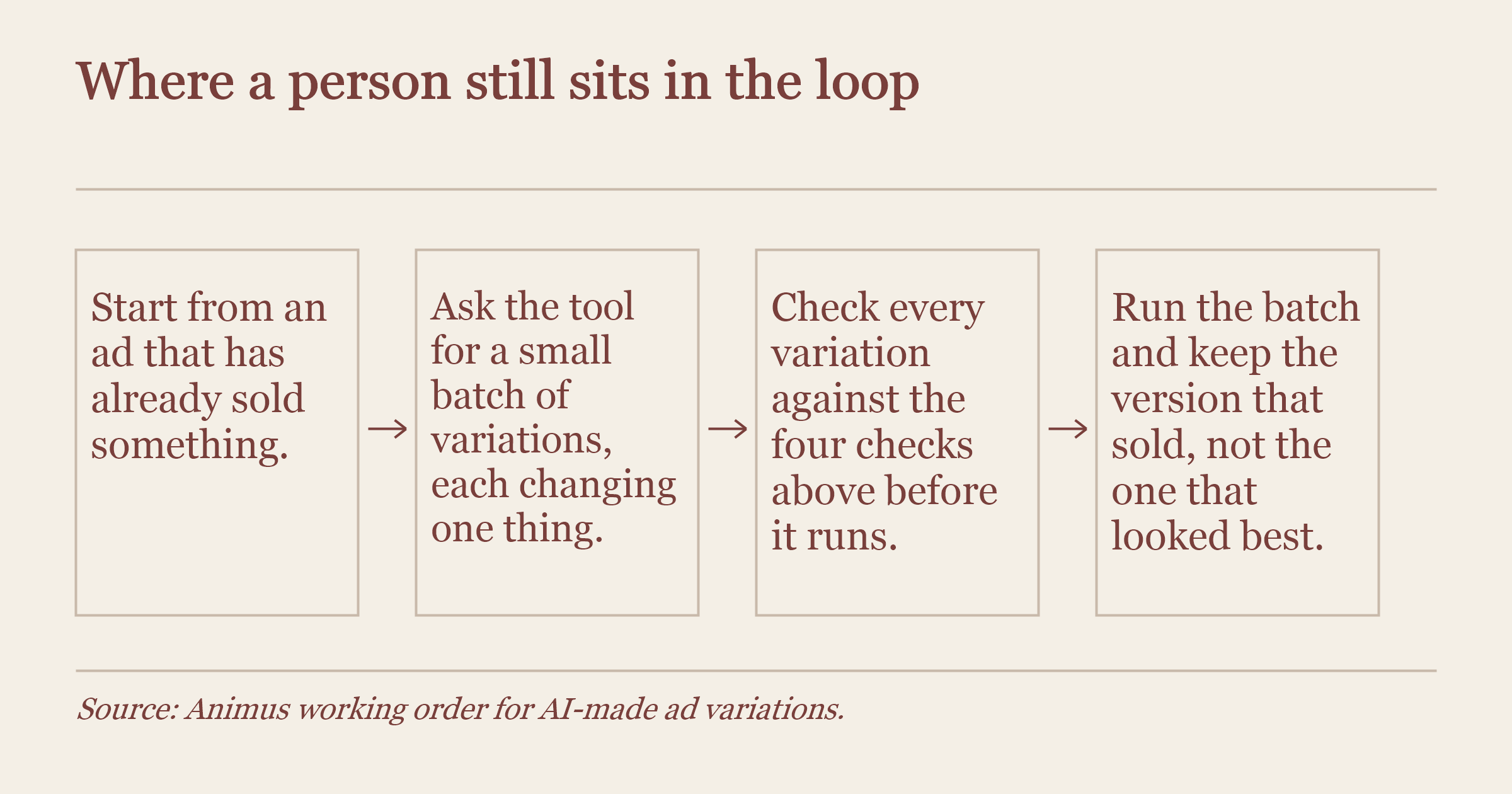
The last step is where most of the value sits. An ad that looked best in review and an ad that sold are often different ads, and only your own sales record can tell them apart.
What to Do With the Next Announcement Like This One
Read a vendor customer story for what the tool accepts, and look elsewhere for what it achieves. This one tells you that asking for many versions of your best ad is now an ordinary thing to type. It does not tell you that those versions will sell. We covered how to separate a vendor’s product from its promise in what an industry-specific AI tool is actually selling you.
If you want a second pair of eyes on a batch of AI-made ads before they run, book a strategy call and bring the original ad that sold.