Georgia’s State Board of Workers’ Compensation now requires every attorney and every unrepresented party to state, under penalty of perjury, whether AI helped prepare a filing. The order is dated August 26, 2026, and it took effect the same day. It does not ban AI. It makes the person who signs the document answer for every sentence and every citation in it, and it prohibits evidence that was made or altered by AI and passed off as genuine.
For most small employers, a workers’ compensation claim is handled by an insurer and its lawyers. The order still reaches you in two places: when you represent yourself before the Board, and when you hand over evidence such as photos, receipts or records that someone may have edited. It also shows, in unusually plain language, where a regulator draws the line on AI-assisted work. That line is worth knowing before you use AI on anything that carries your name.
Want this built for you?
Animus Engine installs the marketing brain and the engine that runs on it. A human hand on every gate.
What Georgia’s AI Order Requires, in Plain Terms
The order governs AI used to prepare briefs, motions and other written submissions that any person files with the Board. Its definition of “use of AI” is broad: relying on any generative AI tool to draft, summarize, edit, verify or analyze legal or factual content in a filing. The spell check and grammar tools built into a word processor do not count.
- Who must certify: attorneys and unrepresented parties who file with the Board.
- When: on every filing, whether or not AI was used. There is a statement for each case.
- Where: at the end of the document, before the signature.
- What else: any evidence created or modified with AI is disclosed to the Board when it is submitted.
The Board also says what the order does not do. Parties remain free to argue the facts of a claim and to file arguments without legal citations at all. The stated aim is transparency and accountability, not a prohibition.
Tell Us the Task That Eats Your Week
Name one marketing job you’d hand off tomorrow. We’ll send back how we’d run it with AI — the steps, the tools, and where a human stays in charge. A real reply from Chris within one business day.
The Two Certifications, Side by Side
| Situation | What the filing must say | What the signer is vouching for |
|---|---|---|
| AI helped draft, edit, review or check the filing | That the document was prepared with the assistance of one or more AI tools | That they reviewed the whole document for accuracy and applicable law, and verified that every citation exists and supports the point it is cited for |
| No AI was used | That no part of the document was prepared using any AI tools or platforms | The absence of AI, also under penalty of perjury |
The second row is the one people miss. A filer who used no AI still signs a statement, so the question gets asked on every filing. Hall Booth Smith associate Brandon Hornsby Wilson, writing for WorkersCompensation.com, expects the research side to cause the most adjustment: an AI summary of case law can no longer be cited without reading the cases it names.
Who the Rule Reaches Inside a Small Business
If an insurer’s attorney handles your claim, the certification is theirs to sign. The order puts unrepresented parties under the same duty as attorneys, so a business owner who files with the Board directly signs the same statement a lawyer would. If you are unsure whether anything you send counts as a filing, ask the attorney or insurer handling the claim before you use AI on it.
The evidence rule reaches further, because evidence often starts with the employer. A photo of a worksite, a scanned receipt, a timecard export or a short video clip can all end up in a claim file. If anyone used an AI tool to clean up, crop, enhance or rebuild that material, the Board now expects to be told.
AI-Generated Evidence: The Line the Board Drew
The order sorts AI-made evidence into two categories, and only one of them is allowed. Evidence that is openly disclosed as made or modified by AI may be submitted. Evidence presented as authentic when AI made or manipulated it is prohibited.
Acknowledged vs. Unacknowledged AI Evidence
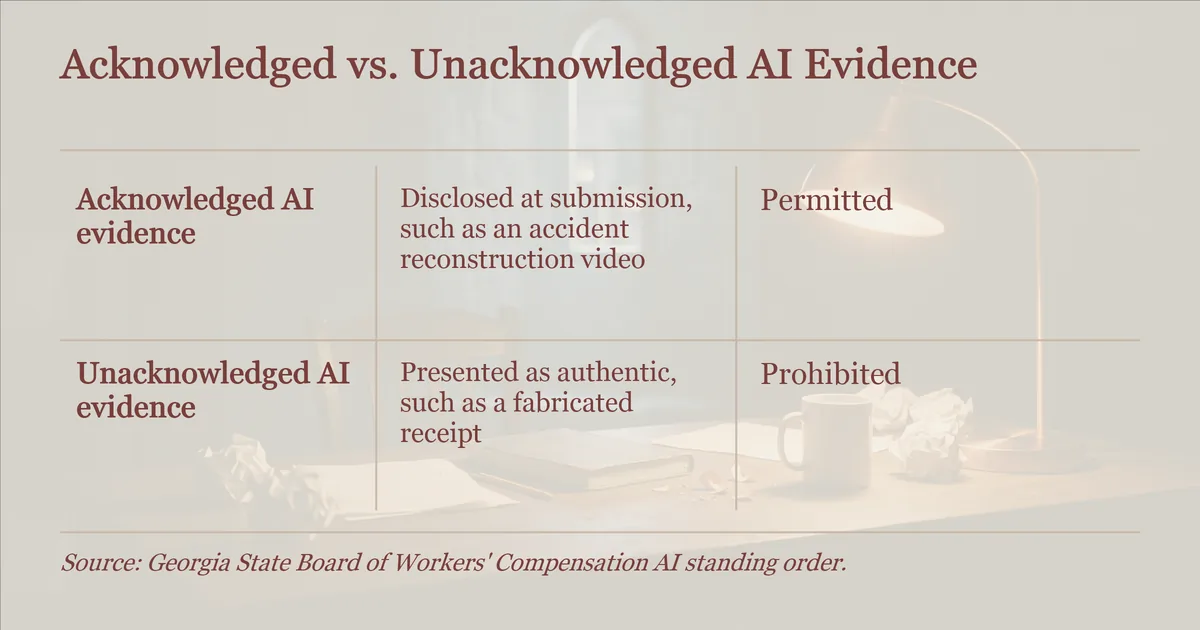
- Acknowledged AI evidence. Disclosed at submission, such as an accident reconstruction video. Permitted.
- Unacknowledged AI evidence. Presented as authentic, such as a fabricated receipt. Prohibited.
The Board’s own examples of the prohibited kind are deepfake videos, fabricated receipts and manipulated photographs. Its examples of the permitted kind are accident reconstruction videos and expert analysis tools. The difference is not the tool. It is whether the Board was told.
What a Violation Costs
The order cites a Georgia statute, O.C.G.A. section 34-9-18(a), under which a person who willfully fails to follow a Board order or directive is assessed a civil penalty of $100 to $1,000 per violation. Undisclosed AI-generated evidence can also lead to referral to the Criminal Investigation Division of the Board’s Enforcement Division, and the order points to O.C.G.A. section 34-9-19, the penalty for false or misleading statements made to obtain or deny benefits.
Two more lines close the obvious exits. Mistake, lack of expertise and time pressure are not accepted as good-faith excuses. And an argument that rests on a case citation that does not exist, or that cannot reasonably be read to support the point, violates the order by itself.
Why This Rule Matters Beyond a Comp Claim
The order is written for one Georgia board, and it should be read that way. It does not govern your website, your ads or your customer emails. What it does show is the standard an official body reached when it decided how to treat AI-assisted documents: the tool is allowed, the human who signs owns every claim, every citation is checked against the original, and anything AI made is labeled as such.
That is the same control we argue for in marketing work. A claim in an ad, a statistic in a blog post and a quote in a case study all carry the business’s name, and an AI draft can invent any of them. Our guide to the controls that matter before you publish AI content covers the editorial side, and our note on AI risk for a small business covers which decisions to make now.
A Review Routine Before AI-Assisted Work Leaves the Building
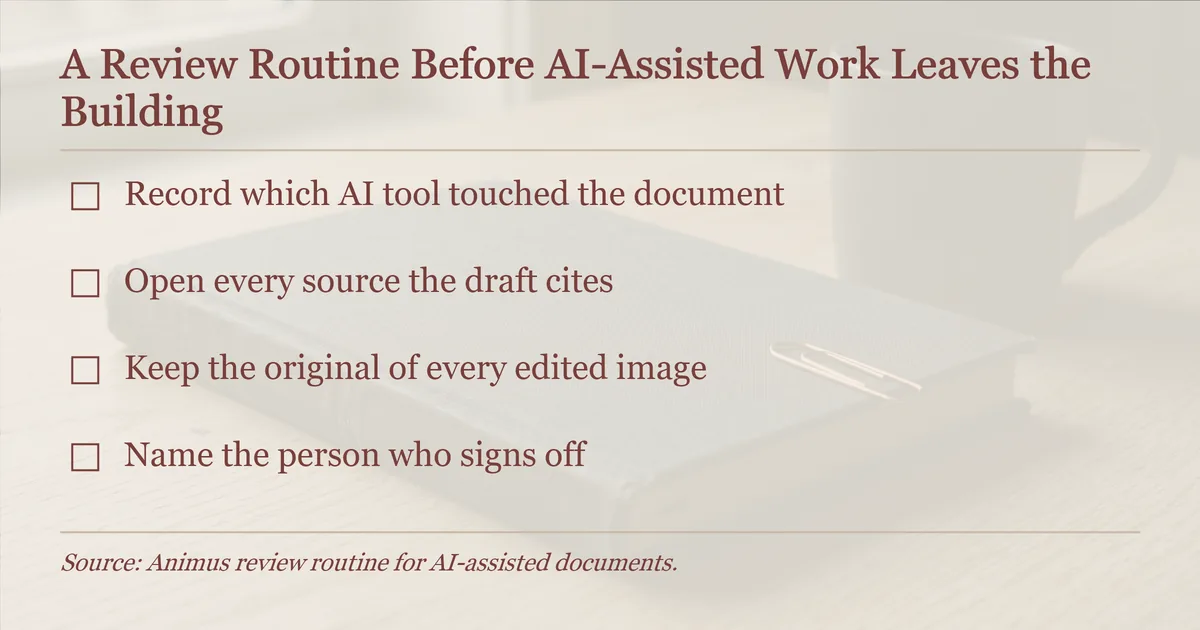
- Record which AI tool touched the document
- Open every source the draft cites
- Keep the original of every edited image
- Name the person who signs off
The first check answers the question the Georgia Board now asks on every filing. The second catches the invented citation, which is the failure the order singles out. The third means you can always show what a photo or receipt looked like before anyone touched it. The fourth puts one name on the result, because the order makes clear that “the tool did it” is not a defense.
Want a review step built into your AI-assisted work? Bring the documents your business sends out most often, and we will work through where a human check belongs in each one. Book a strategy call.
Sources
- Georgia State Board of Workers’ Compensation, “Standing Order: Directive of the Board Regarding Use of Artificial Intelligence and Certification of Citations in Filings”, signed 26 August 2026; accessed 5 October 2026.
- Brandon Hornsby Wilson, “Artificial Intelligence or Allen Iverson: The Georgia State Board of Workers’ Compensation Provides Guidelines Regarding AI,” WorkersCompensation.com, published 1 October 2026; accessed 5 October 2026.
- Hall Booth Smith, the same analysis by Brandon Hornsby Wilson, published 17 September 2026; accessed 5 October 2026.