
An industry-specific AI tool is four products sold in one sentence, and each of the four fails in a different way. OpenAI announced Astra for Law on 17 September 2026, and the description it publishes in its own news feed reads: “OpenAI for Law brings frontier intelligence for law, custom firm workflows, connected legal data sources, and legal-grade controls for confidential client work.” That sentence was written for law firms. The shape of it is the shape of every industry-specific AI tool that will be pitched to your business in the next year.
You are probably not shopping for legal research software. The announcement is worth reading anyway, because it is unusually legible: the vendor has compressed the whole offer into one line, and that line separates cleanly into four claims. Most buyers evaluate the first claim and sign for all four. We have written separately about what a law firm can delegate to AI without creating an ethics problem. This is the other half of the question, and it applies to any trade.
Want this built for you?
Animus Engine installs the marketing brain and the engine that runs on it. A human hand on every gate.
What OpenAI Published on 17 September 2026, and What Would Not Open
OpenAI’s public news feed carries exactly one title, one sentence and one date for Astra for Law, and the announcement page behind it returned an error to both of our automated readers. We read the feed at openai.com/news/rss.xml on 21 September 2026. It returned HTTP 200 and 738,503 bytes. One item inside it carries the title “Introducing Astra for Law”, the description quoted above, and a publication date of Thursday, 17 September 2026.
That item’s own link points at openai.com/index/astra-for-law, and the page did not open for us. Two separate automated readers requested it on 21 September 2026 and both received HTTP 403. We ran a control in the same minute: openai.com’s home page returned HTTP 200 to the same tooling, so the refusal is specific to that path rather than evidence that the site was unreachable. This is a statement about two readers on one date. It is not a claim about what you see in a browser.
What Three Routes Returned
| Route we requested | HTTP status, 21 September 2026 | What it establishes |
|---|---|---|
| openai.com/index/astra-for-law | 403 | The announcement page did not open for either of our automated readers. |
| openai.com/news/rss.xml | 200 | The feed opened, and it carries the title, the one-sentence description and the date. |
| openai.com/ | 200 | The control. The site was reachable from the same tooling in the same minute. |
The consequence for a buyer is small and real. The only vendor text about this product that we can quote with a receipt is one sentence long. Everything else we found was somebody else’s summary of a page we could not read, and a summary is not a source. So the rest of this article works with the sentence, which turns out to be enough.
Tell Us the Task That Eats Your Week
Name one marketing job you’d hand off tomorrow. We’ll send back how we’d run it with AI — the steps, the tools, and where a human stays in charge. A real reply from Chris within one business day.
Industry-Specific AI Tools Are Sold on Four Claims at Once
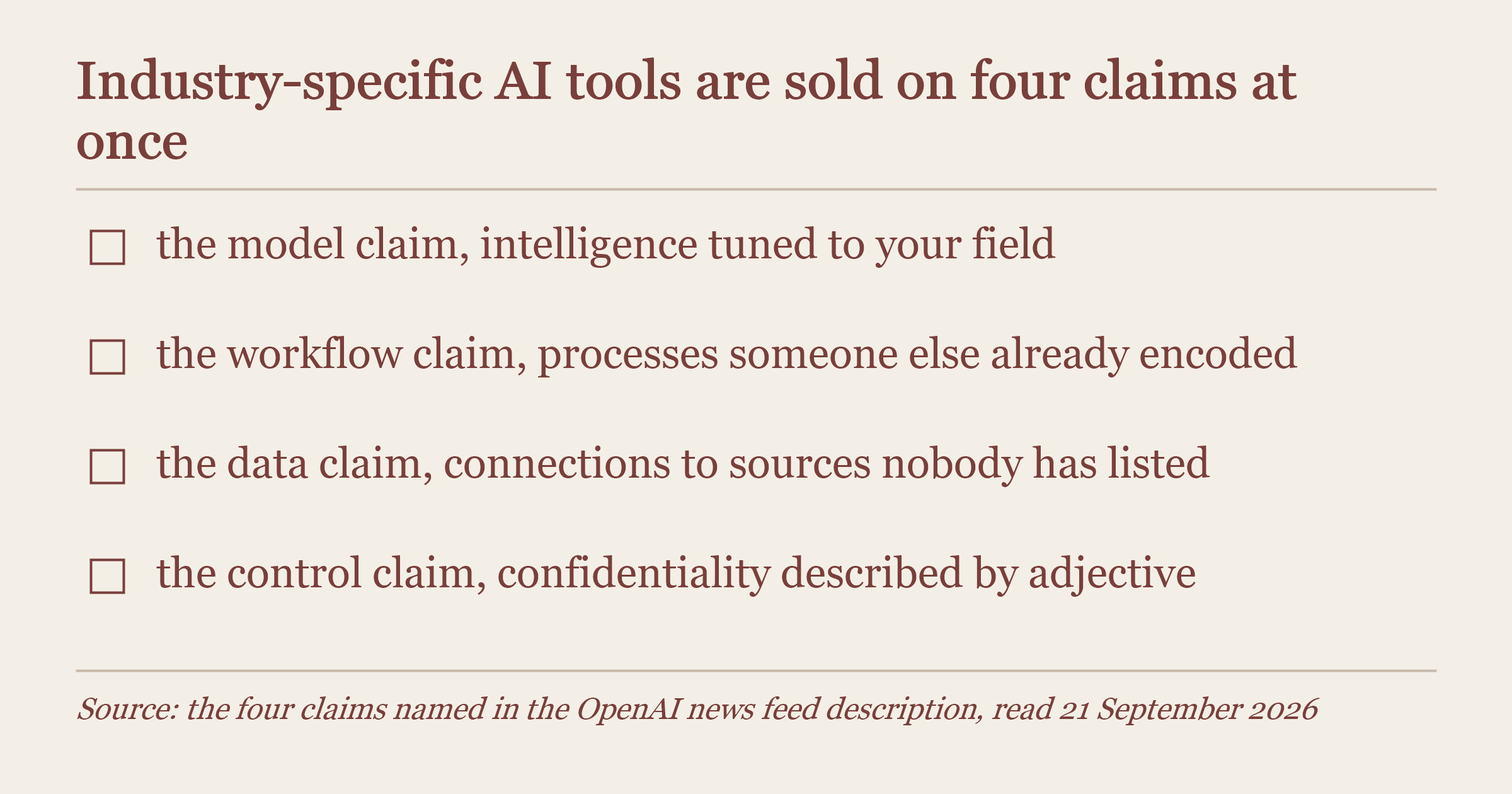
Industry-specific AI tools make four claims in one breath, and the four are independent of each other. Named in order, they are the model claim, intelligence tuned to your field; the workflow claim, processes someone else already encoded; the data claim, connections to sources nobody has listed; and the control claim, confidentiality described by adjective. Split OpenAI’s sentence and all four sit in plain view, one phrase each.
Every one of those phrases is a statement by the party selling the thing. That makes it a real fact about what the vendor says it offers, and not evidence that the offer performs. Independence is the part that costs money. A tool can carry an excellent model and no connection to the records you actually work from. It can carry both and hold your data under terms you would not sign if you read them. The model is the part you can feel in an afternoon, so the model is the part that gets tested, and the other three arrive with it.
Claim One: Intelligence Tuned to the Field
The model claim is the only one of the four you can test for free, and the test takes three pieces of your own real work rather than a demo. Bring work you already know the answer to. Take three finished jobs from your own files, the ones where you remember what went wrong and why, and put them through the tool. Read the output for the thing only a practitioner notices: the assumption a generalist would make and you never would.
A tool tuned to your field gets that right more often than a general one. What the vendor’s adjective cannot tell you is where the tuning stops. “For law” covers a field containing both house conveyancing and capital markets. “For construction” covers a roofer and the general contractor on a hospital. Ask which part of the field the tuning was built against, and ask before the demo, because the demo will be assembled from the part it does best.
Claim Two: Workflows Built Around Your Firm
A prebuilt workflow is a claim that somebody has already encoded how your work runs, so the question is whose version of the work they encoded. Someone had to decide what a job is, which stage follows which, who signs off, and what the finished output looks like. Those decisions are inside the product now.
If they match how you work, you have bought months of setup. If they do not, you have bought an argument you will have every week with software that cannot be persuaded. The check is cheap: name the one process in your business that is genuinely yours, the thing you do differently and would not change, and ask to see it built in the tool during the evaluation rather than described. A vendor who builds it in front of you has answered. A vendor who explains that the product is configurable has not.
Claim Three: Connections to Your Field’s Own Sources
The data connection changes a tool’s output more than the model does, and it is routinely described with no list attached. “Connected legal data sources” is four words doing a great deal of work. A connection to a complete and current record is a different product from a connection to a partial one, and the sentence reads identically either way. The description we were able to read names no specific source, and whatever list exists sits on the page that would not open for us, so we are not going to describe it.
For your own purchase the questions are which sources, how current, and what happens when one of them is wrong. The third matters most and gets asked least. Every connected system eventually returns a confident answer built on a stale record, and the thing that saves you is knowing which record it came from. A tool that shows its source on every answer can be checked. A tool that does not is a tool you have to trust.
Claim Four: Controls Sized to Confidential Work
The control claim is the only one of the four you cannot test from outside, which is why it belongs in the contract rather than on the page. “Legal-grade” is the vendor’s own adjective for its controls, and an adjective is not a term. No published grade of legal confidentiality exists that software either meets or fails.
What exists is a set of specific commitments a vendor can put in named form: how long your data is retained, whether it is used to train anything, which subprocessors touch it, which region it sits in, and what is deleted when you leave. Ask for those five in writing and keep the reply. A vendor who answers plainly has told you most of what you need to know about how they will behave when something goes wrong.
Four Questions to Send Before You Sign
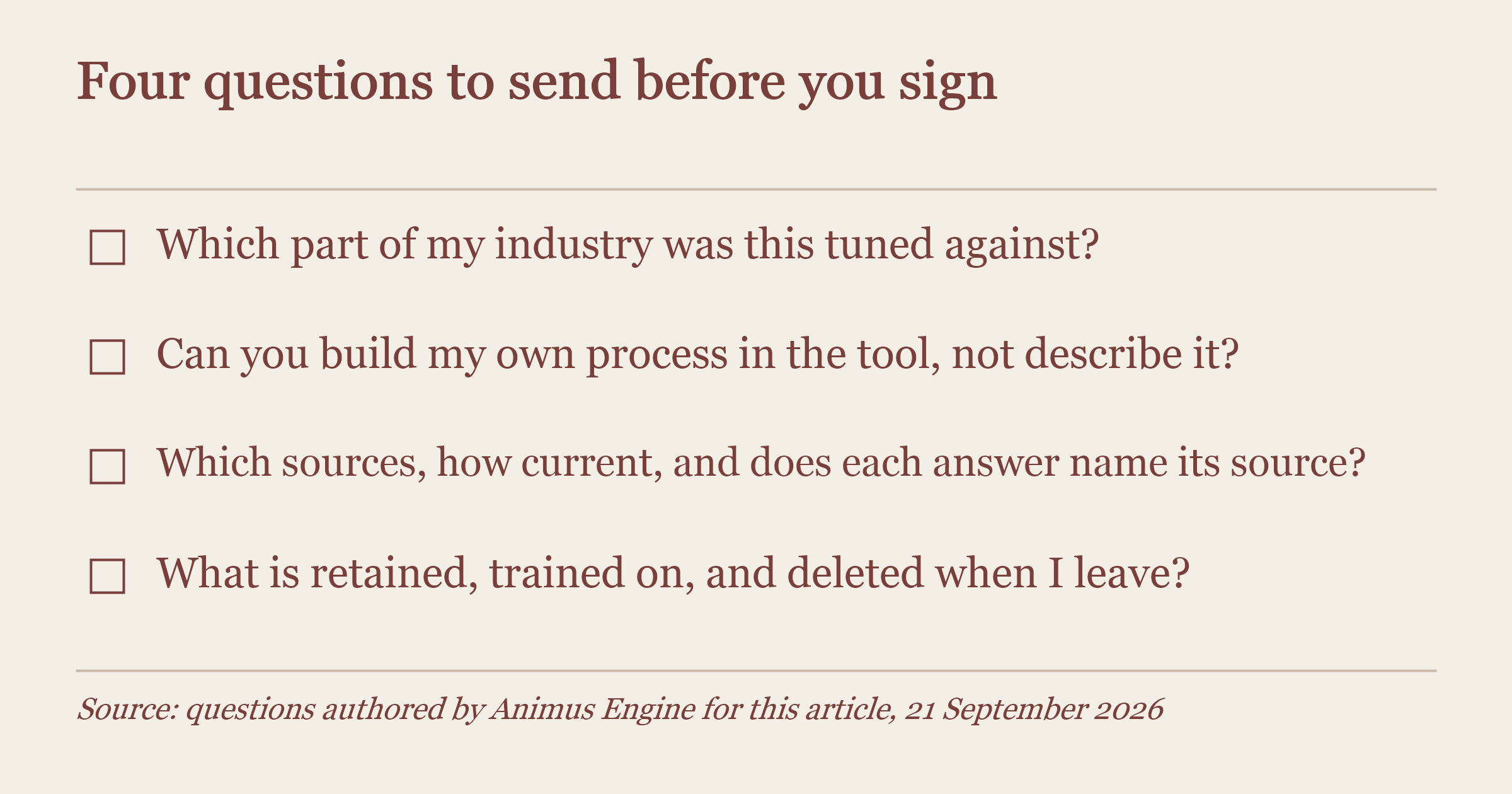
Send four questions by email before you sign anything, and keep the reply as part of the file. The list is ours rather than an industry standard. It is one question per claim, and it is short enough that a vendor cannot reasonably decline to answer it.
- Which part of my industry was this tuned against?
- Can you build my own process in the tool, not describe it?
- Which sources, how current, and does each answer name its source?
- What is retained, trained on, and deleted when I leave?
Question three is the one people leave out, and an announcement like this is what makes it newly relevant. A tool sold on its connections carries a dependency that you are taking on as well, one step removed. That is not disqualifying. It is a fact you are entitled to hold before it becomes your problem. Question four is the one to keep the written answer to, because it is the only one whose cost lands after you have already left.
How We Handle This in Our Own Work
We keep the record of decisions in a workspace the client owns, so the hardest thing to rebuild is never the thing held hostage. Positioning, voice, strategy and the log of what was decided and why sit where the client can read them without asking us. Work is dispatched from that record, and it is verified before anything ships.
When we cannot verify something, a page that will not open or a figure we cannot trace, we say so in the draft instead of writing around it. This article is an instance of that rather than a claim about it. The four questions apply to us as much as to anyone selling into your industry, and we would rather you asked them. You can book a strategy call or send an email, and if you want the wider picture first, our guide to building the system before you buy the tool covers the same ground for marketing work.