
Before you buy software from a very small company, ask three questions and get the answers in writing: who holds the payment relationship with your customers, who holds the customer record, and what leaving actually looks like. On 15 September 2026 a product called tiun finished first on Product Hunt’s daily leaderboard with a one-line promise — “Auth, billing, and payments for AI builders.” That promise is aimed at developers, not at you. It is worth your attention anyway, because it describes the machinery underneath the next generation of tools you will be sold.
A leaderboard rank is not a quality verdict and we do not treat it as one. What the launch usefully marks is a direction of travel. The plumbing that used to take a software company a year to assemble now installs in an afternoon, which means the vendor pitching you a booking tool or an invoicing tool next quarter may be three people and a stack they did not build. That is not a reason to refuse them. It is a reason to read the contract differently.
Want this built for you?
Animus Engine installs the marketing brain and the engine that runs on it. A human hand on every gate.
What an All-in-One Backend Actually Bundles
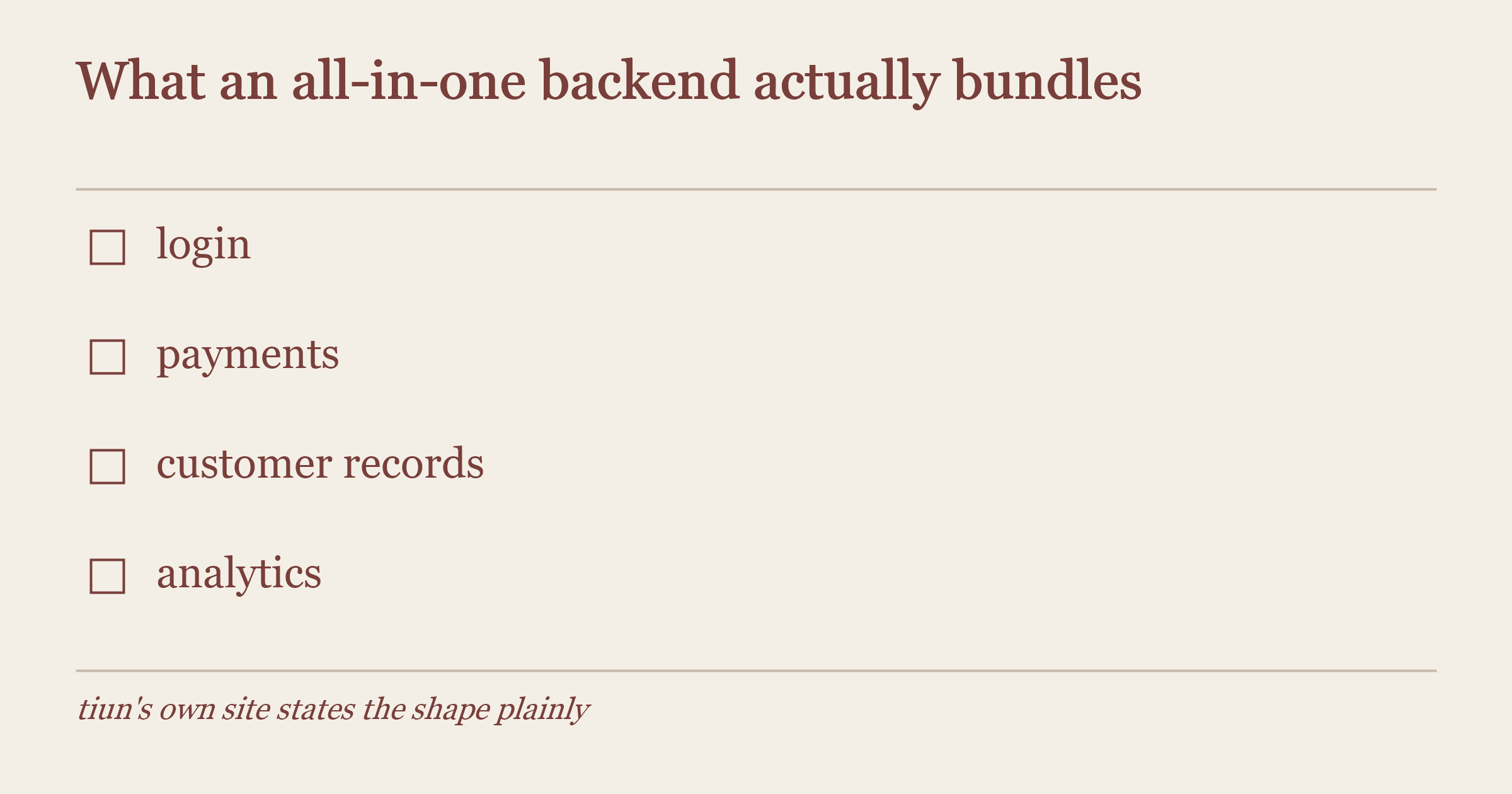
An all-in-one backend collapses four separate vendor relationships — login, payments, customer records and analytics — into one. tiun’s own site states the shape plainly: “One system for auth, payments, customer database, and analytics,” offered so that “AI and SaaS companies” get “the backend they need to ship, scale, and grow their business in one unified platform.” Its Product Hunt listing adds the install story: one command, and a paid product the same day you start building.
Read that as a description of engineering effort removed, because that is what it is. Nothing in it is a claim about the vendor who eventually sells to you. The reason it matters to a buyer is arithmetic. When four systems become one, four separate failure points become one, four separate exports become one, and four separate contracts become one. Consolidation is not automatically bad. It is a decision that used to be made deliberately over four negotiations and is now made once, quickly, by someone optimising for shipping speed rather than for your exit.
Tell Us the Task That Eats Your Week
Name one marketing job you’d hand off tomorrow. We’ll send back how we’d run it with AI — the steps, the tools, and where a human stays in charge. A real reply from Chris within one business day.
Merchant of Record Is the Clause That Changes the Relationship
Merchant of record means the platform, not the vendor you hired, is the legal seller on the transaction — and if your customers pay through that tool, it is the name that can appear on their statement. tiun’s site states this directly: “tiun processes your payments, acts as your Merchant of Record, and pays out monthly.” For the builder, that is a genuine convenience, because invoicing and tax handling stop being their problem.
For a small business one layer further down the chain, it is a question worth asking out loud. If a scheduling tool takes deposits from your clients, the answer to “who is the seller of record here” determines who your client calls about a disputed charge, whose refund policy governs, and whose payout schedule decides when the money reaches you. Monthly payout is a cash-flow fact, not a footnote. None of this makes the arrangement wrong. It makes it a term you should be able to state from memory before you sign.
The Customer Record Is the Asset, Not the Feature
The customer database is the part of a bundled backend you would most want to take with you, and it is the part most often described as a feature rather than as your property. Every one of these platforms markets the unified customer view — one place where transactions, activity and analytics sit together. That view is genuinely useful while you are inside it.
The question is what the record looks like on the way out. A list of email addresses is not the same asset as a list of email addresses carrying purchase history, consent timestamps and communication history. We read tiun’s public marketing page and its Product Hunt listing on 20 September 2026 and found no statement about data export on either. That is an observation about two pages, not a finding about the product; the answer may sit in documentation we did not open. It is exactly the kind of thing that belongs in an email to the vendor rather than in an assumption.
What Leaving Looks Like Belongs on the Page
Every software purchase has an exit, and the exit is almost never described in the sales material. This is not deception. Vendors write pages about arriving because arriving is what buyers read about.
The practical consequence is that the cost of leaving gets discovered at the worst possible moment, which is after you have already decided to go. Losing the structure of a record is not the same as losing the record, and it is the more common outcome: appointment history that exports as a flat list with no customer linkage is still data, and it is no longer an asset. Ask what the export contains, in what format, and whether it preserves the relationships between records. Ask while the tool is still holding nothing.
Consolidation Is Not the Mistake
One vendor holding four functions is often the right call for a small business, because the alternative — four vendors, four bills, four support queues and four integrations you maintain yourself — carries a real cost that lands on someone who has other work to do. We are not arguing that you should assemble your own stack. Most of the time you should not.
What we argue is that the decision should be made with the exit visible. This is the position we hold across everything we build: autonomy is fine when it is governed, and a system you cannot inspect is a system you cannot correct. Buying a bundle is a delegation. Delegation works when you can see what was delegated and take it back.
Put These Five Questions in Writing
Send five questions by email before you sign anything, and keep the reply. A vendor who answers them plainly has told you most of what you need to know about how they will behave later. The list is ours, not a standard the industry publishes.
- Who is the merchant of record on payments my customers make through this tool, and whose name appears on their statement?
- What is the payout schedule, and what is the longest delay between a customer paying and the money reaching my account?
- If I cancel, what can I export, in what format, and does the export preserve the links between customers, transactions and history?
- Which parts of this product are yours, and which are a third-party platform you build on?
- If that platform changes its terms or stops operating, what happens to my account?
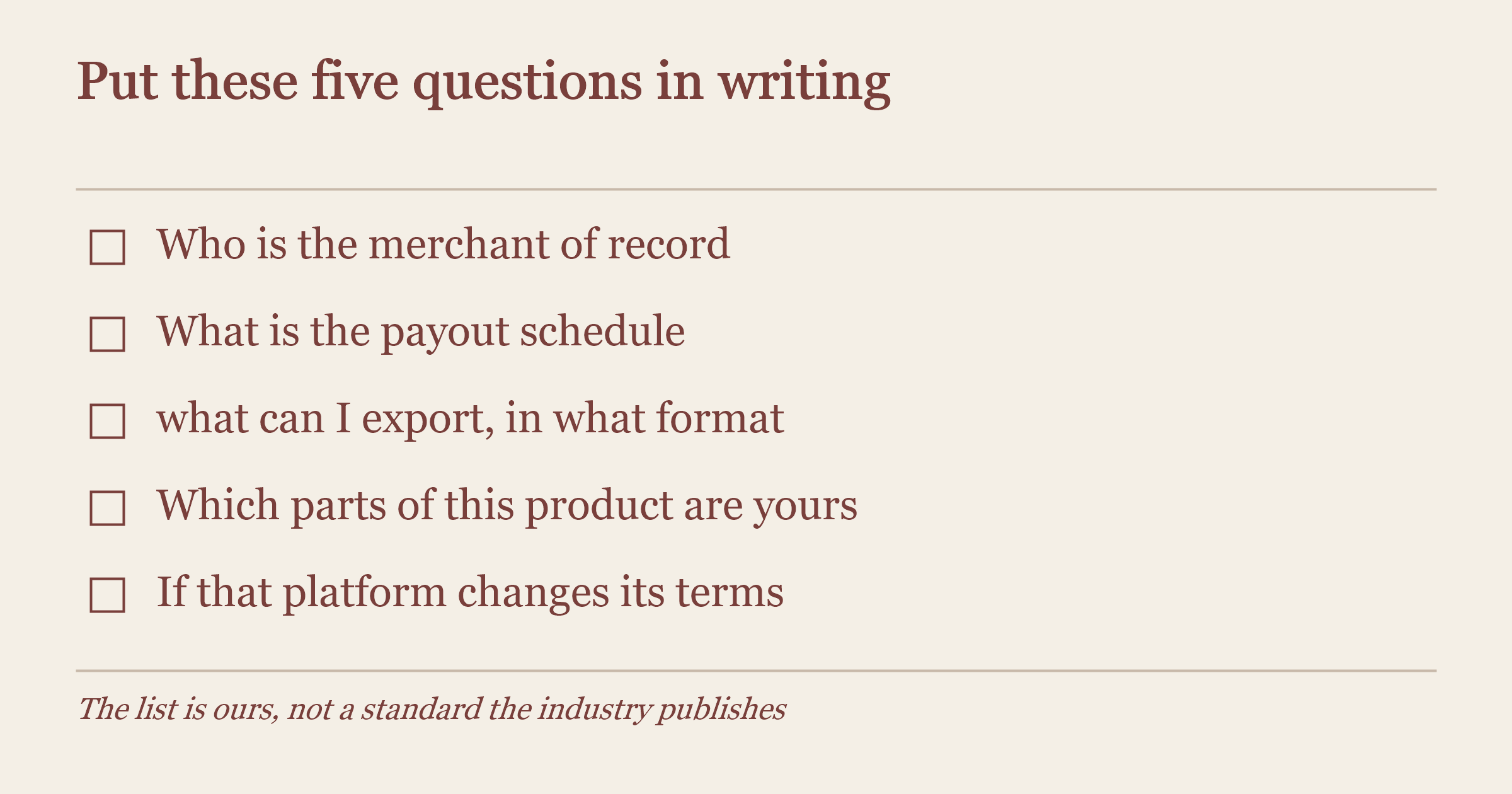
Question four is the one people leave out, and it is the one this launch makes newly relevant. A vendor built on a bundled backend carries a dependency that you are also taking on, one step removed. That is not disqualifying. It is a fact you are entitled to know before it becomes your problem.
How We Handle This in Our Own Work
We keep the record of decisions in a workspace the client owns, so that the thing hardest to re-create is never the thing held hostage. Positioning, voice, strategy and the log of what was decided and why sit where the client can read them without asking us. Work is dispatched from that record, and it is verified before anything ships.
We say this as a description of how the system is built, not as a claim that it makes us the right choice for you. The same five questions apply to us, and we would rather you asked them. If you want to talk it through, the door is an email and a real conversation.