AI ads are ads that Google’s and Meta’s own systems help write, place and pay for. In an IAB survey of US advertising executives, 83% said their company had deployed AI in the creative process, up from 60% in 2024. What those tools still leave to you is the budget, the limits on who sees the ad, and the decision about what your brand will and will not say.
That split is the part worth learning before you switch anything on. Google’s Performance Max and AI Max, and Meta’s Advantage+, can write headlines, choose placements and move money between them. None of them knows what your business can deliver this week, what you can afford to lose on a test, or which claim would land you in trouble with a customer.
Want this built for you?
Animus Engine installs the marketing brain and the engine that runs on it. A human hand on every gate.
What AI Ads Automate, and What Stays With You
On both platforms, the AI decides which version of the ad runs, where it runs and how the budget is spread, while you set the goal, the spending limit and the exclusions. Google describes Performance Max as a campaign that combines the assets and settings you provide with Google AI to serve across all of its inventory. Meta describes Advantage+ as a set of products that applies AI across a campaign’s audience, placement and budget.
What the Platform Decides and What You Decide
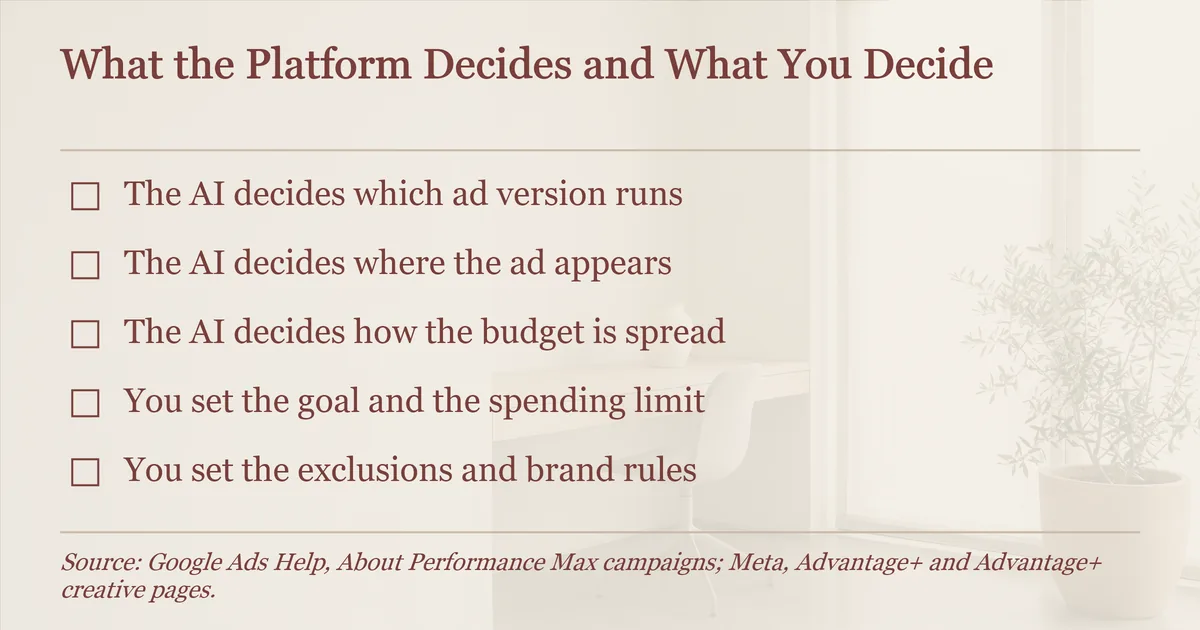
- The AI decides which ad version runs
- The AI decides where the ad appears
- The AI decides how the budget is spread
- You set the goal and the spending limit
- You set the exclusions and brand rules
The first three lines are what you hand over. The last two are what nobody at Google or Meta can set for you, because they depend on your stock, your margins and your customers. Most of the trouble with AI ads starts when those two are left at their defaults.
Tell Us the Task That Eats Your Week
Name one marketing job you’d hand off tomorrow. We’ll send back how we’d run it with AI — the steps, the tools, and where a human stays in charge. A real reply from Chris within one business day.
What Google Ads Automation Decides for You

Google Ads automation now reaches the ad text, the landing page and the bid, and Google’s help pages say you remain responsible for what it generates. In a Performance Max campaign, Smart Bidding sets each bid in a real-time auction based on how likely the click is to convert. Text customization generates extra headlines and descriptions from your landing page, your domain and your current ads. Final URL expansion lets Google replace the page you chose with one it judges more relevant, and write a matching headline and description.
Google’s help page on Performance Max is direct about who answers for the result: if you turn on final URL expansion, you remain responsible for reviewing the landing page content and all dynamically generated assets for compliance and accuracy. AI Max for Search campaigns brings search term matching, text customization and final URL expansion into ordinary Search campaigns.
Google states a result for AI Max as well. Advertisers that activate it in Search campaigns will typically see 14% more conversions or conversion value at a similar cost per acquisition or return on ad spend, according to the help page. The page gives the basis as Google internal data from 2025, for advertisers outside retail. That is Google’s own measurement of its own product, so treat it as the vendor’s claim to test, not a forecast for your account. We looked at what the Shopping version of AI Max hands over in Google Ads AI Max for Shopping: What the One-Click Upgrade Hands Over.
What Meta’s Advantage+ Automates
Meta’s Advantage+ applies AI across a campaign’s audience, placements and budget, and Advantage+ creative generates and adjusts the ad variations themselves. Meta says Advantage+ creative uses AI to generate and enhance ad variations across single image, video and carousel formats. You can see a preview of some samples before you publish, and Meta says you can turn the enhancements off at any time.
The preview is the limit to remember. Meta states that the previews are examples of possible versions and do not represent an exhaustive list of every variation that might run. You approve a sample, and the system runs versions you have not seen. If a variation the system produced would be a problem for your business, the place to stop it is the setting, before launch, not the preview. Our article on AI ad variations covers the checks to run on each version you do see.
Google and Meta AI Ad Settings, Side by Side
| Setting | What the AI does | What you keep |
|---|---|---|
| Google Smart Bidding | Sets each bid in a real-time auction from the predicted chance of a conversion | The conversion goal and an optional cost or return target |
| Google text customization | Writes extra headlines and descriptions from your landing page, domain and ads | Brand guidelines, and whether the setting is on |
| Google final URL expansion | Swaps your chosen landing page for another and writes matching ad text | Responsibility for the page content and every generated asset |
| Google Performance Max budget | Moves spend toward the inventory and placements performing best | The daily spend target, brand exclusions and placement exclusions |
| Meta Advantage+ | Applies AI across audience, placement and budget | The product page names no specific control |
| Meta Advantage+ creative | Generates and enhances image, video and carousel variations | A preview of some samples, and the switch to turn enhancements off |
Read the right-hand column as your job description for AI ads. Five of the six rows leave you a setting, and in most of them it is a limit rather than a creative choice. Where Meta’s page names no control, the budget and goal you enter at setup are the only limits you can be sure of.
What Customers Think of AI-Made Ads
Younger customers feel less positive about AI-made ads than advertisers assume, and the gap grew between 2024 and 2026. IAB and Sonata Insights surveyed 505 US consumers aged 16 to 43 and 104 US advertising executives between October 2025 and January 2026. 82% of the executives believed these consumers felt very or somewhat positive about AI-generated ads. 45% of the consumers said they did.
Where Ad Executives and Consumers Disagree
| Question | Ad executives | Consumers |
|---|---|---|
| Feel very or somewhat positive about AI-generated ads | 82% believe consumers do | 45% do |
| Call a brand that uses AI for ads “forward-thinking” | 46% | 22% |
| Call a brand that uses AI for ads “manipulative” | 10% | 20% |
| Call a brand that uses AI for ads “unethical” | 7% | 16% |
The same study found that 39% of Gen Z respondents felt very or somewhat negative about AI ads, close to double the 20% of Millennials. For a business whose customers skew young, that is a reason to look hard at what the AI generates before it runs, not a reason to avoid the tools. The study also found that 73% of these consumers said knowing an ad was made with AI would either raise their likelihood to buy or make no difference.
Who Is Responsible for an AI-Made Ad

The advertiser is responsible for an AI-made ad, including its disclosure, even when the platform generated the creative or shows the label. Mumbrella reported that the IAB’s AI Transparency and Disclosure Framework puts ultimate responsibility for disclosure on the advertiser, even when a platform such as Meta, Google or TikTok displays the AI label.
According to that report, the framework says AI-generated images and video made from prompts should carry a disclosure unless they are obviously non-realistic. AI-written copy does not automatically need one. Routine edits such as retouching, colour correction and upscaling are exempt unless they create a material risk that a customer would be misled. The IAB study found the habit lagging: 89% of advertisers who have used generative AI to make ads disclose it at least sometimes, and fewer than half always do. If the realistic video is an AI clone of you, our guide to using a HeyGen clone as a real estate agent sets out what YouTube, Meta and the NAR Code of Ethics expect you to disclose.
Google’s help page says the same thing in its own terms for generated assets. Whatever the label says, the ad is yours. That matters most for a small business, because a misleading ad costs you a customer you see in person, not an impression in a report.
Five Settings to Make Before You Switch on AI Ads
Make five decisions before you turn on an AI ad campaign: the goal, the spending limit, the exclusions, the generated-text rules and the review habit. Each one maps to a control that Google’s or Meta’s pages say you keep. If the goal and budget are not written down yet, start with our guide to planning an advertising campaign with one goal, one budget and one end date.
The Five Settings, in Order
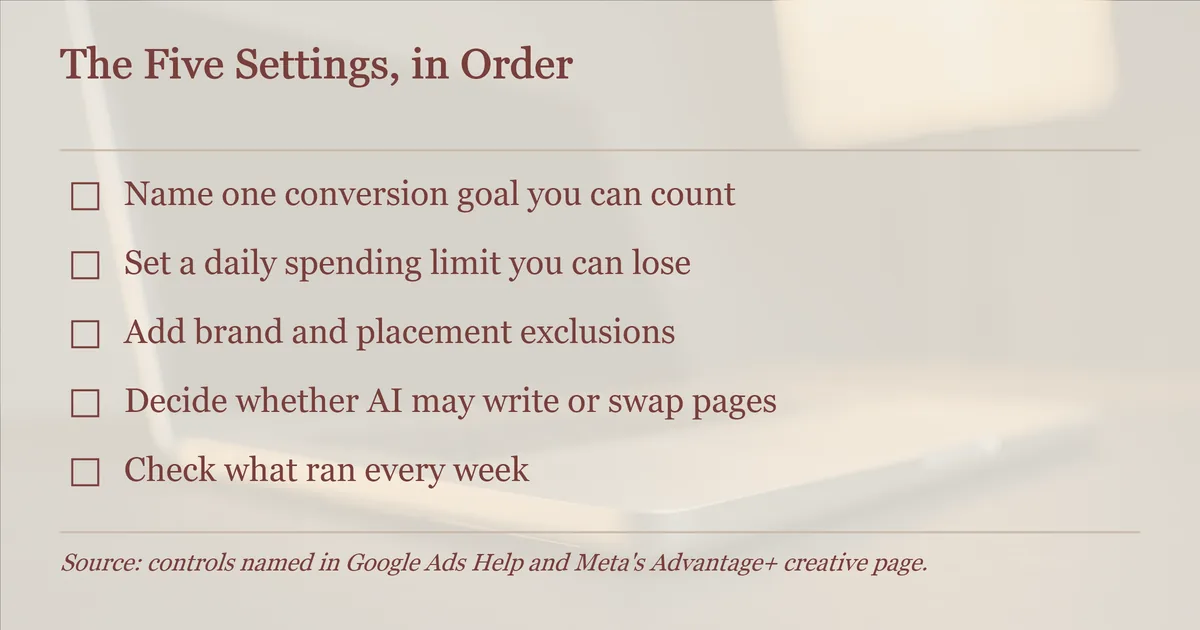
- Name one conversion goal you can count
- Set a daily spending limit you can lose
- Add brand and placement exclusions
- Decide whether AI may write or swap pages
- Check what ran every week
Take a hypothetical bakery in Pittsburgh running its first Performance Max campaign for holiday cake orders. It names one goal, completed order forms, and sets a daily limit it could lose for a month without missing payroll. It keeps final URL expansion off, so a click on a cake ad cannot land on the catering page, and leaves text customization on with brand guidelines set. Every Monday the owner reads the asset report and the search terms and turns off anything that promises a delivery the bakery cannot make. If you are still deciding whether paid search is worth it at all, start with our guide to that question.
Want a second pair of eyes on your AI ad settings? Bring your Google Ads or Meta Ads Manager account, and we will go through the five settings with you before the next campaign goes live. Book a strategy call.
Sources
- Google Ads Help, “About Performance Max campaigns”, accessed 9 October 2026.
- Google Ads Help, “About AI Max for Search campaigns”, accessed 9 October 2026.
- Meta for Business, “Meta Advantage+”, accessed 9 October 2026.
- Meta for Business, “Meta Advantage+ Creative”, accessed 9 October 2026.
- IAB and Sonata Insights, Debra Aho Williamson, Jack Koch and Caroline Giegerich, “The AI Gap Widens”, published 15 January 2026; accessed 9 October 2026.
- Mumbrella, Eleanor Dickinson, “IAB US lays out precise AI disclosure requirements for ads”, published 1 October 2026; accessed 9 October 2026.